Zurich Travel Guide 2026: Honest Costs, Smart Itinerary, and What Locals Actually Recommend
site: switzerlandvibe.com
focus_keyword: zurich travel guide
meta_title: “Zurich Travel Guide 2026: Honest Costs & Smart Itinerary”
meta_description: “Plan your 2026 Zurich trip with exact CHF prices, 1-3 day itineraries, the Zürich Card breakdown, and a local’s verdict on what is actually worth it.”
author: Anna Berger
date: 2026-04-27
Zurich Travel Guide 2026: Honest Costs, Smart Itinerary, and What Locals Actually Recommend
By Anna Berger — Swiss tourism writer specializing in budget travel and alpine destinations. Last updated: April 2026.
Disclosure: Some links in this article are affiliate links. If you book through them, SwitzerlandVibe may earn a small commission at no extra cost to you. We only recommend services we use ourselves.
Quick Answer
Zurich rewards visitors who plan with precision. Budget CHF 124 to 286 per day depending on style, set aside two to three days, and use the Zürich Card (CHF 27 for 24 hours, CHF 53 for 72 hours) to cover transit and museum entries. The most rewarding visits combine the Altstadt, Lake Zurich, and a quick alpine hop up Uetliberg.

Let me be direct: Switzerland costs more than France or Italy. A coffee or train ticket carries a higher price tag. But you aren’t paying for excess; you’re paying for precision, quality, and a seamless experience where everything functions impeccably. In return, you receive a city that is pristine, efficient, and scenically breathtaking, where the urban and alpine exist in perfect harmony. Zurich is Switzerland’s largest city and main international gateway, known for its financial prowess, its sparkling lake, and a surprising depth of culture nestled within its compact, walkable core. With the Zurich region recording 7.5 million overnight stays in 2025 (Source: Zurich Tourism, 2026), its appeal is clear. This guide strips away the clichés to give you the precise, actionable information you need to plan a visit that is worth every franc.
What Makes Zurich Worth Visiting in 2026?
Zurich merits your visit because it offers a rare synthesis of urban sophistication and immediate natural escape, all executed with Swiss precision. Beyond the postcard-perfect Old Town and glittering lake, 2026 presents a compelling cultural moment, notably at the Kunsthaus with a major Edvard Munch and Maria Lassnig exhibition from October 2026 to February 2027. The city’s continuous evolution is visible in districts like Zurich West, where industrial heritage fuels a vibrant creative scene. It’s a place where you can ascend a forested mountain by tram for panoramic views and be back for an aperitif on the Limmat riverbank within the hour. Zurich rewards the traveler who values quality, scenic beauty, and seamless logistics.
How Much Does a Trip to Zurich Actually Cost?
The cost is significant, but strategic planning transforms expense into investment. A mid-range traveler should anticipate spending approximately CHF 286 per day, inclusive of accommodation, meals, local transport, and entry fees (Source: BudgetYourTrip 2026). The key is knowing where the Zurich Card offers value and where to seek out authentic, high-quality experiences that don’t rely on a luxury budget. Spending wisely here means prioritizing efficient transport passes, museum entries, and the occasional memorable meal over disposable souvenirs.
Daily Budget Breakdown by Traveller Type
Your daily expenditure in Zurich varies dramatically based on choices in accommodation, dining, and mobility. Here is a realistic breakdown for 2026.
| Traveller Profile | Accommodation (Night) | Food & Drink (Day) | Transport & Attractions (Day) | Estimated Daily Total |
|---|---|---|---|---|
| Budget-Conscious | Hostel dorm: CHF 45-65 | Self-catering & lunch specials: CHF 35 | Zurich Card & free sights: CHF 27 | CHF 124 |
| Mid-Range | 3-star hotel/boutique: CHF 180 | Cafe lunch + restaurant dinner: CHF 70 | Zurich Card & paid attractions: CHF 36 | CHF 286 |
| Luxury | 5-star hotel: CHF 450+ | Fine dining & bars: CHF 150+ | Private tours & taxis: CHF 37+ | CHF 637+ |
Where to Actually Save Money
Save money by using Zurich’s excellent public infrastructure and cultural offerings. The Zürich Card (CHF 27 for 24 hours, CHF 53 for 72 hours) is your single best tool, covering all transit within the city and region, including the boat trip on Lake Zurich and the train to the airport, plus free or discounted entry to most museums. Seek out Mittagsmenü (lunch specials) at restaurants for CHF 20-25, a fraction of evening prices. Filling your water bottle from the city’s countless pristine fountains saves both money and plastic. For accommodation with character at a lower price point, look to the neighborhoods just outside the core, like District 4 or 5, which are well-connected by the ZVV network.
How Many Days Do You Need in Zurich?
You need a minimum of two full days to appreciate Zurich’s core contrasts: one for the historic Altstadt and lake, and a second for Uetliberg mountain and a modern district like Zurich West. With three days, you can add a quintessential Swiss day trip, such as Lucerne or a Rhine Falls excursion. Zurich’s compact size makes it efficient to explore, so even a single day can be rewarding if well-structured.
1-Day Zurich Itinerary
A one-day visit requires focus. Start early at Lindenhof for a quiet city panorama. Walk through the Altstadt (Niederdorf) on the east bank of the Limmat, cross the Münsterbrücke to admire both Grossmünster and Fraumünster, and view the famed Chagall windows inside the latter (CHF 5). Stroll the Bahnhofstrasse, then take tram 11 or a walk to Bellevueplatz for a lakeside promenade. Conclude with a late afternoon ascent via the S10 train (covered by a city zone ticket) to Uetliberg for the definitive sunset view over the city, lake, and Alps.
2-Day Itinerary
Day 1: Dedicate to history and culture. Follow the 1-day Altstadt and lake promenade itinerary, but include time to climb the Grossmünster tower (CHF 5) and visit the Kunsthaus Zurich (CHF 23, or free with Zurich Card on Wednesdays). If the schedule aligns, the 2026 Munch+Lassnig exhibit is a priority.
Day 2: Focus on contrasts. Morning: Take the S-Bahn to Zurich West. Explore the Viadukt arches with its boutique shops and the Freitag Tower. Visit the Swiss National Museum (across from the Hauptbahnhof) if history interests you. Afternoon: Journey to Kilchberg via S-Bahn S8 (13 minutes) to the Lindt Home of Chocolate (CHF 15 entry with Zurich Card discount), an immersive experience that is surprisingly compelling.
3-Day Itinerary (with Day Trip)
Follow the 2-day itinerary. On Day 3, take a day trip. The most efficient and rewarding is Lucerne: a 45-minute direct train (full fare ~CHF 25 one-way, free with Swiss Travel Pass) to a storybook city on a lake with mountain views. Walk the Chapel Bridge, explore the Musegg Wall, and take a short lake cruise. Alternatively, the powerful Rhine Falls near Schaffhausen (1-hour direct train) make for a impressive natural spectacle.
What Are the Best Things to Do in Zurich?
The best activities balance Zurich’s historic charm, its stunning natural setting, and its contemporary cultural energy. It is about the experience of moving effortlessly from a medieval lane to a lakeside swim to a world-class museum within a few hours.
Altstadt and the Historic Core
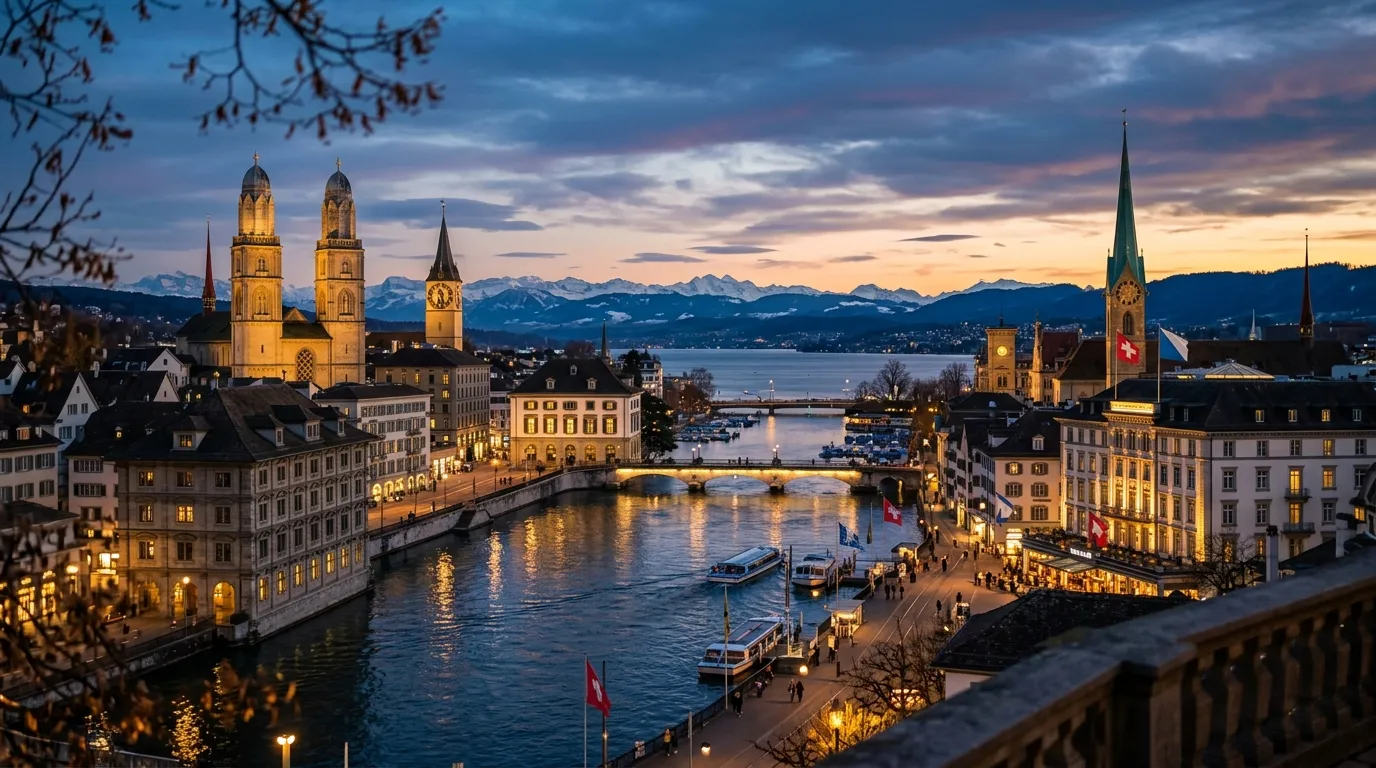
The heart of Zurich is its well-preserved Altstadt, split by the Limmat River. On the east bank, Niederdorf’s cobbled lanes are lined with boutique shops and cafes. The west bank holds the imposing Grossmünster, with its climbable tower for the best central panorama, and the Fraumünster, renowned for its luminous stained-glass windows by Marc Chagall. The quiet plaza of Lindenhof, a former Roman fort, offers a free, postcard view over the old town rooftops.

Lake Zurich and the Promenade
The lake is Zurich’s living room. The promenade from Bellevue to Zurichhorn park is a essential stroll, perfect for people-watching and dipping your feet in the clear water. For the best perspective, take a ZSG public boat (included with the Zurich Card or a ZVV ticket) from Bürkliplatz. A short cruise to Rapperswil or a simple round trip reveals the city’s elegant skyline against a backdrop of distant alpine peaks.

Uetliberg — The City Mountain
Zurich’s own mountain, accessible year-round via a 25-minute ride on the S10 train from Hauptbahnhof. The summit (at 871m) provides a sweeping Panorama Trail with viewing platforms overlooking the entire city, lake, and, on clear days, a chain of alpine giants. It’s the quintessential Zurich experience and a favorite local escape for hiking and sledding.
Kunsthaus and the Cultural Side
The Kunsthaus Zürich houses Switzerland’s most important art collection, with a particular strength in Modernism. Its claim to the largest collection of Edvard Munch’s work outside Norway is significant. The modern extension by architect David Chipperfield is a masterpiece itself. For 2026, the planned Munch and Maria Lassnig exhibition (Oct 2026 – Feb 2027) is a major draw. The Swiss National Museum, located in a castle-like building next to the main station, offers a thorough and engaging overview of Swiss cultural history.
Zurich West — The Modern District
This former industrial zone is the engine of Zurich’s contemporary culture. The Viadukt—a series of railway arches now housing design shops, markets, and restaurants—epitomizes the area’s transformation. The Prime Tower offers a sleek bar on its upper floors. Nearby, the Freitag store, built from stacked shipping containers, and the innovative restaurants and galleries of the Löwenbräu arts complex define Zurich’s cutting-edge creative scene.
How Do You Get Around Zurich?
You get around Zurich using the superlative Zürcher Verkehrsverbund (ZVV) network of trams, buses, S-Bahn trains, boats, and funiculars. It is punctual, clean, comprehensive, and intuitive. For virtually all tourism within the city, a tram is seldom more than a few minutes’ walk away.
From the Airport to the City
Zurich Airport (ZRH) is seamlessly connected. Direct S-Bahn trains (lines S2, S16, S24) depart from beneath the airport arrivals hall and reach Zürich Hauptbahnhof (HB) in 10-15 minutes. The standard single ticket for this 2-zone journey costs CHF 7.20. Trains run from approximately 5:00 AM to just after midnight. This service is included in the Zurich Card and all Swiss travel passes.
ZVV Network and the Zürich Card
A single ticket for zones within central Zurich (110/111) costs CHF 3.10 for a 1-hour short-distance trip. For tourists, the Zürich Card is almost always superior value. For CHF 27 (24h) or CHF 53 (72h), it provides unlimited 2nd class travel in the entire city and region (including the airport train and lake boats), free entry to most museums, and discounts on other attractions. Calculate: a return airport trip (CHF 14.40) plus two tram rides (CHF 6.20) and one museum (CHF 20+) already exceeds the 24-hour card price.
When to Upgrade to the Swiss Travel Pass
Upgrade to the Swiss Travel Pass if your itinerary includes multiple long-distance day trips within an 3, 4, 8, or 15-day period. While the Zurich Card covers the local region, the Swiss Travel Pass provides unlimited travel on trains, buses, and boats across the entire country, plus free entry to national museums. If you plan to visit Lucerne, Bern, Interlaken, or the Alps from Zurich as a base, the pass quickly pays for itself and represents the ultimate in travel convenience.
Where Should You Stay in Zurich?
Stay in District 1 (Altstadt) for historic charm and walkability to top sights, though hotel prices are highest here. District 4 (Aussersihl) and District 5 (Zurich West) offer more contemporary vibes, excellent transport links, and better value, with a wealth of boutique hotels and design hostels set in converted industrial buildings. For lake views and a quieter, upscale atmosphere, consider Enge or Seefeld on the west and east shores of the lake, respectively. A quality 3-star hotel will typically range from CHF 150 to 250 per night, with prices sensitive to season and demand.
When Is the Best Time to Visit Zurich?
The best time is late spring (May-June) or early autumn (September-October). You enjoy mild temperatures, fewer crowds than peak summer, and generally pleasant weather for walking and lake activities. Summer (July-August) is vibrant, with frequent public swims in the lake and open-air festivals, but it is also the most crowded and expensive period. Winter (December-February) has its own magic, with Christmas markets in December and the potential for snow, though days are short and colder. For a balance of good weather and manageable tourism flow, the shoulder months are my clear recommendation.
Booking Tip
For most visitors, comparing rates on Trip.com before locking in a hotel saves between 8 and 15 percent compared with walk-in rates, particularly for the boutique 3-stars in District 5. If your trip pivots around Zurich as a base for alpine day trips, booking a flight via Aviasales tends to surface the cheapest ZRH connections that traditional engines miss. For travellers planning side excursions to the Black Forest or Liechtenstein, GetRentacar offers the broadest selection at Zurich Airport.
For a deeper read on alpine logistics, see our guides to the Swiss Travel Pass and the best hikes near Zurich.
Day Trips Worth Taking from Zurich
Zurich’s central location and superb rail network make it an ideal hub for exploring a diverse slice of Switzerland. These day trips each offer a distinct facet of the Swiss experience, all within a 90-minute train journey.
| Destination | Journey Time (Train) | Key Experience | Why It’s Worth It |
|---|---|---|---|
| Lucerne | 45-50 min | Lakeside medieval city with mountain vistas | Iconic Swiss postcard scenery; compact, walkable historic center with the Chapel Bridge and Lion Monument. |
| Rhine Falls, Schaffhausen | 55 min (to Neuhausen) | Europe’s most powerful waterfall | A raw natural spectacle; boat trips get you close to the cascading water; combine with the old town of Stein am Rhein. |
| Bern | 55 min | UNESCO-listed federal capital | Stunning arcaded old town, bear park, and a more laid-back capital city atmosphere. |
| Mount Rigi | ~1h 45min | Classic “Queen of the Mountains” panorama | A quintessential alpine excursion involving train, boat, and cogwheel railway, all often covered by the Swiss Travel Pass. |
| St. Gallen | 1h | Baroque Abbey Library (UNESCO) | A world-class historical library in a charming eastern Swiss city known for its embroidered textiles. |
My verdict: Zurich is a city that rewards clarity of planning. Approach it not as a budget-breaking obstacle, but as a masterclass in quality living. Invest in the right transit pass, prioritize experiences over things, and allow time to simply be by the lake or on a mountain trail. Its value extends far beyond the receipt for a perfectly brewed coffee.
For more itinerary ideas, see our complete Swiss Travel Pass review and the Lucerne day trip guide.
Frequently Asked Questions
Is Zurich worth visiting for 3 days?
Yes. Three days strikes the right balance — two days for the city itself (Altstadt, lake, Uetliberg, Kunsthaus, Zurich West) and one day for a quintessential Swiss excursion to Lucerne, the Rhine Falls, or Mount Rigi. Anything shorter forces compromises; anything longer is better spent moving on to the Bernese Oberland or Ticino.
What is the cheapest way to visit Zurich?
The cheapest path combines hostel dorms in District 4 or 5 (CHF 35-55 per night), Coop or Migros groceries for breakfast and lunch (50-60% cheaper than restaurants per BudgetYourTrip 2026), and the Zürich Card for transport plus museum entries. A frugal traveller can keep daily costs to roughly CHF 95-110 with discipline.
Is Zurich better than Geneva for tourists?
For most travellers, yes. Zurich offers a denser concentration of historic sights, easier alpine access, livelier nightlife, and a more characterful old town. Geneva’s appeal lies in international institutions and Lake Geneva. Zurich also has the more efficient ZVV transit network. Both are expensive, but Zurich tends to deliver more variety per franc.
Do I need to speak German in Zurich?
No. Zurich is highly international, and English is widely spoken in hotels, restaurants, museums, and public transit. Signage at stations and major attractions is multilingual. A few polite Swiss German phrases (Grüezi for hello, Merci vielmal for thank you) are appreciated but never required.
How safe is Zurich for tourists?
Zurich is among the safest major cities in Europe, with low rates of violent crime and reliable public services. Standard urban precautions apply — petty pickpocketing can occur in crowded areas around Hauptbahnhof and Bahnhofstrasse during peak season. Lost wallets are frequently returned through the city’s Fundbüro.
Can you swim in Lake Zurich?
Yes. Lake Zurich water is clean and tested regularly. Public bathing areas (Badis) along the promenade — including Strandbad Mythenquai and Seebad Utoquai — offer changing facilities, sunbathing platforms, and food kiosks for around CHF 8 entry. Locals swim from May through September, with peak conditions in July and August.
Is the Zurich Card worth it?
Yes, for most visitors staying more than 24 hours and using public transit plus visiting at least one museum. At CHF 27 for 24 hours or CHF 53 for 72 hours, it covers all ZVV transit (including the airport train and lake boats) plus free or discounted entry to the major museums. A single airport return trip and one museum already cover the daily cost.
What is the best month to visit Zurich?
June stands out for the balance of long daylight, comfortable temperatures (averaging 22°C), lake swimming season opening, and lower crowds than July-August. September offers similar conditions with autumn colours and harvest events. December is exceptional for Christmas markets if you accept short days and cold temperatures.
How far is Zurich from the Alps?
Closer than most travellers expect. Uetliberg, Zurich’s own city mountain, is 25 minutes by S-Bahn. The full alpine experience — Mount Rigi, Mount Pilatus, the Bernese Oberland — sits within 1.5 to 2 hours by direct train. This proximity is precisely what makes Zurich a superior alpine base compared with cities like Geneva or Basel.
Are restaurants in Zurich open on Sundays?
Most are, with reduced hours. Tourist-area restaurants in the Altstadt, Niederdorf, and around the lake operate on standard schedules. Supermarkets close on Sundays except those at Hauptbahnhof and the airport, which run extended hours. Plan your Sunday meals at restaurants or buy groceries on Saturday before 18:00.
Sources
- SECO — Switzerland tourism record overnight stays 2025 (admin.ch, 2026)
- Federal Statistical Office — Tourism statistics (admin.ch)
- Federal Department of Foreign Affairs — Travel advice for Switzerland (admin.ch)
- Zurich Tourism overnight stays report (Organisator, February 2026)
- BudgetYourTrip Zurich Travel Cost (2026)
- Zürich Verkehrsverbund (ZVV) official fares 2026