Switzerland Travel Budget 2026: Real Costs and Proven Money-Saving Tips
Last Updated: March 2026
Switzerland costs 150-250 CHF per day for a comfortable trip, but smart travelers can reduce that to 80-120 CHF without sacrificing the essential experiences. After 6 years living in Switzerland, I know exactly where the money goes and where you can save without missing out. This guide breaks down every cost category with real 2026 prices and gives you the specific strategies that actually work, not generic advice like “cook your own meals.”
- Backpacker: 80-120 CHF (hostel, supermarket meals, free activities)
- Mid-range: 150-220 CHF (3-star hotel, lunch menus, 1-2 paid activities)
- Comfort: 280-400 CHF (4-star hotel, restaurants, premium activities)
- According to the BFS (2025), the average tourist spends 195 CHF per day in Switzerland
- Switzerland is 50-60% more expensive than neighboring France, Germany, or Italy
Table of Contents
- How to find affordable accommodation in Switzerland?
- How to eat well in Switzerland without overspending?
- What is the cheapest way to travel around Switzerland?
- Which Swiss experiences are free or cheap?
- What budget mistakes should you avoid?
- How does Switzerland compare to its neighbors?
- How we researched this guide
- FAQ
How to find affordable accommodation in Switzerland?
Hostels: the best budget option
Swiss Youth Hostels (youthhostel.ch) are clean, modern, and well-located. Dorm beds: 35-55 CHF including breakfast. Private rooms: 80-130 CHF. The Zurich, Lucerne, and Interlaken locations are particularly good.
Budget tip that most guides miss: Swiss hostels offer half-board (breakfast + dinner) for 15-20 CHF extra. A hostel dinner is 15-20 CHF for a full meal, which is 40-50% cheaper than any restaurant.
Mountain huts (SAC Hutten): the unique option
Swiss Alpine Club huts (sac-cas.ch) cost 35-65 CHF per night with half-board. They are located on hiking trails at altitude, offering experiences no hotel can match. You need to book in advance (especially July-August) and bring a sleeping bag liner.
Airbnb and apartments: best for groups
A studio apartment costs 90-140 CHF per night in cities, 70-100 CHF in smaller towns. For groups of 3-4, apartments beat hotels on price while giving you a kitchen to save on meals. Book through Airbnb or Interhome.ch for verified Swiss properties.
Where to stay cheapest
Avoid Zurich, Geneva, and Zermatt for budget stays. Bern, Lucerne, and Thun offer better value with equal access to attractions. Staying in Lauterbrunnen is 30-40% cheaper than Grindelwald despite being in the same valley.
How to eat well in Switzerland without overspending?
Supermarket strategy
Migros and Coop are the two main supermarkets. Migros is slightly cheaper. Both offer excellent prepared meals:
- Sandwich + drink: 8-12 CHF
- Fresh salad bowl: 7-10 CHF
- Hot meal (ready to eat): 9-14 CHF
- Sushi box: 9-13 CHF
These are genuinely good quality. Many Swiss office workers eat supermarket lunches daily. No shame in it.
The lunch menu hack
Swiss restaurants offer a “Menu of the Day” (Tagesmenu/Menu du Jour/Menu del Giorno) at lunch for 18-25 CHF. The same restaurant charges 35-55 CHF for equivalent dishes at dinner. Always eat your main restaurant meal at lunch.
Ethnic food: the budget savior
Turkish, Thai, Indian, and Chinese restaurants in Swiss cities serve full meals for 14-20 CHF. In Zurich, Langstrasse (district 4) has dozens of affordable ethnic restaurants. In Bern, the Lorraine quarter offers similar options.
Free water everywhere
Every public fountain in Switzerland dispenses drinkable water (unless marked with “Kein Trinkwasser / Eau non potable”). Fill your bottle constantly. A bottle of water at a restaurant costs 5-7 CHF. This alone saves 10-15 CHF per day.
What is the cheapest way to travel around Switzerland?
Swiss Travel Pass: the math
The Swiss Travel Pass costs: 3 days (267 CHF), 4 days (324 CHF), 6 days (401 CHF), 8 days (434 CHF), 15 days (473 CHF). It covers all trains, buses, boats, city transport, 500+ museums, and gives 50% off most mountain railways.
The pass pays for itself if you make 2+ inter-city trips and 1 mountain excursion. Example: Zurich-Lucerne return (50 CHF) + Lucerne-Interlaken return (66 CHF) + Pilatus 50% discount (savings of 53 CHF) = 169 CHF value in 2 days. A 3-day pass at 267 CHF is already nearly paid for.
Supersaver tickets
If you plan point-to-point trips, SBB Supersaver tickets (sbb.ch, available 60 days in advance) offer 30-50% discounts. Zurich-Bern: from 17 CHF (normal: 51 CHF). Zurich-Lugano: from 23 CHF (normal: 69 CHF). Non-refundable and tied to a specific train.
Half-Fare Card
The Half-Fare Card (185 CHF for 1 year, 120 CHF for 1 month) halves all train, bus, boat, and most mountain railway prices. If your trip is longer than 10 days or you plan many mountain excursions, this can beat the Swiss Travel Pass.
Which Swiss experiences are free or cheap?
Completely free
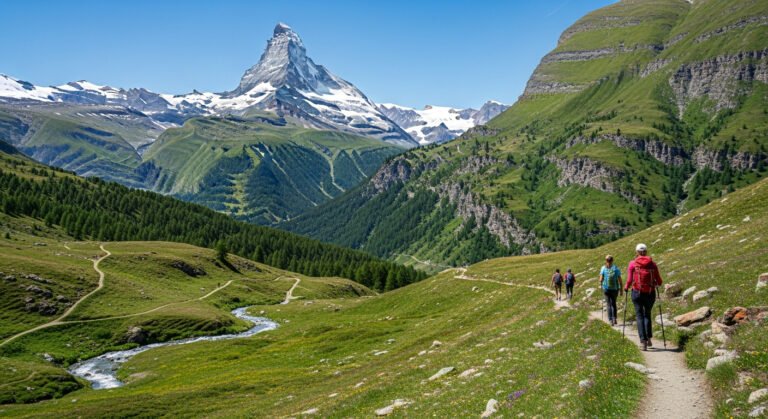
- Hiking: Switzerland has 65,000 km of marked hiking trails, all free. The most spectacular ones (Lauterbrunnen Valley, Five Lakes Walk from Sunnegga, Oeschinensee) cost nothing beyond getting there.
- Lake swimming: Every Swiss lake is clean enough to swim in and free to access. Locals swim in the Aare (Bern), Lake Zurich, and Lake Geneva all summer.
- City Old Towns: Zurich, Bern, Lucerne, Basel, and Fribourg all have free-to-explore historic centers with remarkable architecture.
- Mountain viewpoints: Many panoramic viewpoints are accessible by car or short walk. Harder Kulm viewpoint above Interlaken charges for the funicular (16 CHF) but the Schynige Platte trail offers similar views for free.
- Fountains and public art: Bern has 100+ decorative fountains. Basel has the Tinguely fountain. All free.
Under 15 CHF
- Trummelbach Falls, Lauterbrunnen: 11 CHF
- Chateau de Chillon, Montreux: 13.50 CHF (free with Swiss Travel Pass)
- Matterhorn Museum, Zermatt: 12 CHF
- Gruyere cheese factory tour + tasting: 7 CHF
- Einstein House, Bern: 8 CHF
What budget mistakes should you avoid?
- Buying water at restaurants: A small bottle costs 5-7 CHF. Ask for “Hahnenwasser” (tap water) instead. Some restaurants charge for it (1-2 CHF), but most will bring it free if you also order food.
- Eating at tourist hotspots: The restaurant at the Jungfraujoch summit charges 25-30 CHF for a basic meal. Bring a packed lunch from the valley and save 15-20 CHF.
- Not checking mountain webcams: Spending 100+ CHF on a mountain railway only to find clouds at the summit is the most expensive mistake. Always check webcams before departing.
- Buying individual train tickets: If you are making 3+ trips, a Swiss Travel Pass or Half-Fare Card always saves money compared to individual tickets.
- Staying in Geneva or Zurich for your entire trip: These are the two most expensive cities. Use them as gateways and move to cheaper bases like Bern, Thun, or Lucerne.
How does Switzerland compare to its neighbors?
| Item | Switzerland | France | Germany | Italy |
|---|---|---|---|---|
| Hotel (3-star) | 150-200 CHF | 80-120 EUR | 70-110 EUR | 60-100 EUR |
| Restaurant meal | 25-45 CHF | 15-25 EUR | 12-22 EUR | 10-20 EUR |
| Beer at bar | 6-8 CHF | 5-7 EUR | 3.50-5 EUR | 4-6 EUR |
| Public transport | 3-5 CHF/trip | 1.50-2 EUR | 2-3 EUR | 1.50-2 EUR |
The quality differential partially justifies the price: Swiss trains are the most punctual in Europe (92.5% on-time in 2025 according to SBB), food quality standards are among the world’s highest, and infrastructure is immaculate. You pay more, but you get more.
How we researched this guide
FAQ
How much does a week in Switzerland cost?
Budget: 700-900 CHF per person. Mid-range: 1,200-1,800 CHF. Comfort: 2,200-3,500 CHF. These include accommodation, food, transport, and activities but not flights.
Is Switzerland worth the money?
Yes. The combination of scenery, safety, cleanliness, transport quality, and outdoor access is unmatched in Europe. The free hiking and swimming alone justify the trip. Focus spending on 2-3 premium experiences (mountain railways, cheese/chocolate factories) and save elsewhere.
Can I use euros in Switzerland?
Some tourist shops and hotels accept euros, but at unfavorable exchange rates (typically 1:1 when the actual rate is closer to 1:0.95). Use a multi-currency card (Wise, Revolut) for the best rates. ATMs dispense Swiss francs everywhere.
When is Switzerland cheapest to visit?
November and March-April (excluding Easter). Accommodation prices drop 20-30% compared to summer. Many mountain resorts are closed between ski season and summer, so prices in valleys and cities are at their lowest.
Do I need ETIAS?
Yes, since 2025. Switzerland is in the Schengen Area. 7 EUR, valid for 3 years. Apply at etias.ec.europa.eu.
Sources
- BFS (Federal Statistical Office) – Tourist Spending Statistics 2025
- SBB – Official Tariffs and Punctuality Report 2025
- Switzerland Tourism – Budget Travel Guide 2026
- Numbeo – Cost of Living Comparison 2026
Thomas Weber has lived in Switzerland since 2020 and tracks every franc spent on travel. He shares practical budget strategies for visitors on SwitzerlandVibe.