Zurich’s central location and Switzerland’s excellent train system make it the perfect base for day trips to mountains, lakes, medieval towns, and even neighboring countries. Every destination on this list is reachable within 90 minutes by train, making it easy to experience Switzerland’s diversity without changing hotels.
These 10 day trips are ranked by overall experience — combining scenic value, ease of access, cost, and uniqueness. Each includes transport details, costs, and timing to help you plan efficiently.
1. Lucerne and Mount Pilatus — The Classic Swiss Day
Why go: Lucerne delivers the quintessential Swiss experience in a single day — a medieval old town, a stunning lake, and a mountain summit, all connected by boats and railways. The Golden Round Trip to Mount Pilatus is one of Switzerland’s most spectacular excursions, combining a boat cruise across Lake Lucerne, the world’s steepest cogwheel railway, panoramic views from 2,132m, and a gondola/cable car descent.
Getting there: Direct train from Zurich HB to Lucerne (45 minutes, CHF 25 each way or half with Swiss Half Fare Card). The Golden Round Trip starts from Lucerne’s boat pier.
Cost: Train CHF 50 return (CHF 25 with Half Fare). Golden Round Trip CHF 114 (CHF 57 with Half Fare). Total day: approximately CHF 80-170 depending on passes.
Best timing: Leave Zurich at 8am, explore Lucerne’s old town first, then catch the 11am boat for the Pilatus circuit. Return to Zurich by 7pm. Check weather forecasts — clear skies make the mountain trip far more rewarding.
2. Rhine Falls (Schaffhausen) — Europe’s Largest Waterfall
Why go: The Rhine Falls near Schaffhausen is Europe’s largest waterfall by volume — 150 meters wide, 23 meters high, with an average flow of 600 cubic meters per second. The power is genuinely impressive, especially in spring when snowmelt swells the river. Boat trips take you directly to the rock in the middle of the falls for a thrilling perspective.
Getting there: Train from Zurich HB to Neuhausen am Rheinfall (50 minutes, CHF 18 each way). The falls are a 5-minute walk from the station.
Cost: Train CHF 36 return. Boat trip to the rock CHF 7. Total day: approximately CHF 50-60.
Combine with: The medieval town of Schaffhausen (beautiful painted facades, the Munot fortress with free panoramic views) is 5 minutes by train from the falls. Stein am Rhein (30 minutes further) has one of Switzerland’s best-preserved medieval townscapes.
3. Lauterbrunnen Valley — Tolkien’s Inspiration
Why go: Lauterbrunnen Valley has 72 waterfalls cascading down sheer cliff faces that rise 300+ meters on both sides. J.R.R. Tolkien visited and was inspired to create Rivendell. The village of Lauterbrunnen sits at the valley floor with the Staubbach Falls (297m free-fall) visible from the main street. Beyond the valley, cable cars and trains access Mürren, Schilthorn, and the Jungfrau region.
Getting there: Train from Zurich HB to Lauterbrunnen (2 hours 15 minutes, 1 change at Interlaken Ost). CHF 35 each way (CHF 17.50 with Half Fare).
Cost: Train CHF 70 return (CHF 35 with Half Fare). Trümmelbach Falls (waterfalls inside the mountain) CHF 11. Cable car to Mürren CHF 11.20 (CHF 5.60 with Half Fare). Total day: CHF 50-100.
Tip: Visit Trümmelbach Falls (glacial waterfalls inside the rock accessed by tunnel lift) and hike through the valley to Stechelberg. If weather is clear, take the cable car up to Schilthorn for the rotating restaurant with Eiger/Mönch/Jungfrau panorama.
4. Appenzell — Traditional Swiss Culture
Why go: Appenzell is Switzerland’s most traditional region — painted wooden houses, yodeling, alphorn music, and direct democracy practiced in open-air assemblies (Landsgemeinde). The village of Appenzell has an immaculate main street with ornately painted buildings, local cheese shops (Appenzeller cheese is famous), and a museum explaining the region’s unique democratic traditions.
Getting there: Train from Zurich HB to Appenzell (1 hour 45 minutes, 1 change at Gossau). CHF 27 each way.
Cost: Train CHF 54 return (CHF 27 with Half Fare). Museum CHF 9. Cheese dairy visit free. Total day: CHF 40-70.
Combine with: Hike to Ebenalp (cable car CHF 15 with Half Fare) for dramatic cliff-face restaurant Aescher, one of Switzerland’s most photographed buildings — a guesthouse built into a vertical cliff face above a deep valley.
5. Rapperswil — The “Town of Roses”
Why go: Rapperswil sits on the upper end of Lake Zurich with a 13th-century castle, three public rose gardens (15,000+ rose bushes bloom June-October), a wooden footbridge across the lake, and a charming old town. It’s the closest quality day trip from Zurich and one of the least expensive.
Getting there: Train from Zurich HB (35 minutes, CHF 14 each way) or boat from Zurich Bürkliplatz (2 hours, scenic but slower, CHF 27 each way, free with Swiss Travel Pass).
Cost: Train CHF 28 return (CHF 14 with Half Fare). Castle and rose gardens free. Total day: CHF 20-40.
Best timing: June-July for peak rose blooms. The wooden footbridge (Holzsteg) across the lake to Hurden is 841 meters and Switzerland’s longest wooden bridge — walk across and back for lake views.
6-10: More Outstanding Day Trips
6. Mount Rigi (1 hour): The “Queen of Mountains” offers easier, less crowded hiking than Jungfrau region peaks. Accessible by boat and cogwheel railway from Lucerne. Classic round trip combines multiple transport modes. CHF 75 with Half Fare Card. For more information, check out Europe trip finder.
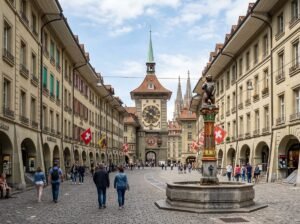
7. Bern (1 hour 10 minutes): Switzerland’s UNESCO-listed capital features medieval arcades, the Zytglogge clock tower, the Aare River swimming, and the Einstein Museum. Train CHF 51 return (CHF 25.50 with Half Fare).
8. Stein am Rhein (1 hour 10 minutes): Perhaps Switzerland’s most perfectly preserved medieval town, with elaborate painted facades on every building in the main square. Combine with Rhine Falls for a full day. Train CHF 40 return.
9. Gruyères (2 hours 15 minutes): The storybook medieval hilltop town that gave the world Gruyère cheese. Visit the cheese factory (Maison du Gruyère), the castle, and the H.R. Giger Museum (Alien designer). Train CHF 80 return (CHF 40 with Half Fare).
10. Konstanz, Germany (1 hour 15 minutes): A German city on Lake Constance accessible without border formalities (though you technically cross into Germany). Significantly cheaper for shopping and dining. The medieval Altstadt and lake promenade are beautiful. Train CHF 30 return.
For longer itineraries, see our complete Switzerland road trip guide and budget tips. Compare flights to Zurich for the best airfares.
Frequently Asked Questions
Which day trip from Zurich is the cheapest?
Rapperswil is the cheapest quality day trip at approximately CHF 20-40 total (train + free attractions). Stein am Rhein is next at approximately CHF 40-50. For the absolute cheapest option, Uetliberg mountain (within Zurich) costs only CHF 8.80 return by S-Bahn and offers stunning panoramic views — technically not a “day trip” since it’s within city limits, but it provides a mountain experience without the typical Swiss mountain price tag.
Which day trip has the best mountain views?
Lauterbrunnen and the Jungfrau region offer the most dramatic mountain scenery, with sheer cliff faces, waterfalls, and glacier-covered peaks. Mount Pilatus from Lucerne offers the best panoramic mountain views relative to effort and cost. For clear-day photography, the Schilthorn (above Lauterbrunnen) provides the iconic Eiger-Mönch-Jungfrau panorama from its revolving restaurant.
Can I do these day trips without a car?
Yes, all 10 day trips are accessible by train and/or boat. Switzerland’s public transport is the world’s best — trains are punctual, clean, frequent, and connect to cable cars, boats, and buses at timed connections. For day trips, the Swiss Half Fare Card (CHF 120 for one month) is essential — it halves the cost of virtually all public transport and mountain railways, paying for itself in just 2-3 day trips.
How many day trips should I plan from Zurich?
For a week-long stay, plan 3-4 day trips with rest days between for exploring Zurich itself and recovering from mountain excursions. A good combination: one mountain trip (Pilatus or Lauterbrunnen), one cultural town (Bern or Appenzell), and one lake/waterfall experience (Rhine Falls or Rapperswil). Doing more than 4 day trips in a week leads to transport fatigue and prevents you from appreciating Zurich’s own considerable charms.
Is it worth buying the Swiss Travel Pass for day trips?
The Swiss Travel Pass (from CHF 232 for 3 consecutive days) includes unlimited trains, buses, boats, and free museum entry. If you’re doing 3+ day trips in a short period, it can save money compared to individual tickets. However, for most visitors making 3-4 day trips spread over a week, the Swiss Half Fare Card (CHF 120 for one month) provides better value — you get 50% off everything and only pay when you travel. Calculate your specific trips using the SBB app to compare both options.
Editorial standards
Why trust this guide
- Route-checked. Itineraries, transfers and timings are verified against current public-transport schedules and operator pages.
- Honest comparisons. Hotel areas and tours are compared on real value — affiliate links never change the recommendation.
- Transparent. Some links are affiliate links; the disclosure is shown on every guide.
This guide is informational travel content, not professional travel, financial or legal advice. Always confirm prices, opening times and conditions with the official provider before you book.