Disclosure: This article contains affiliate links. We may earn a small commission at no extra cost to you if you purchase through these links.
15 Best Swiss Villages to Visit in 2026: Hidden Gems and Iconic Hamlets
Switzerland’s villages are among the most beautiful in the world – Alpine hamlets of carved wooden chalets, flower-filled meadows, and towering glacier peaks that look like living postcards. From car-free Mürren perched above a 300-meter waterfall valley to the Baroque splendor of Appenzell’s painted facades, the best Swiss villages offer an authenticity and natural beauty that Switzerland’s cities cannot match. According to Swiss Tourism, rural village tourism grew 28% between 2023-2025 as travelers sought deeper, slower experiences beyond the main tourist centers.
By Anna Fischer, Switzerland Guide | Published: March 12, 2026
Bernese Oberland: Switzerland’s Alpine Village Heartland
The Bernese Oberland is Switzerland’s most iconic mountain region, home to the most dramatic Alpine villages on earth – presided over by the trio of Eiger, Mönch, and Jungfrau.
1. Mürren – The Most Beautiful Village in Switzerland
Mürren is car-free, which means arriving by cable car from Lauterbrunnen to find a village that time forgot. 400 permanent residents live here year-round surrounded by some of the most extraordinary mountain scenery in the Alps. The Allmendhubel flower trail offers meadows of wildflowers with the Bernese Alps as backdrop.
Why Mürren is unmissable: the view of the Eiger north face from the village bench is one of Europe’s iconic vistas. The Schilthorn cable car ascends to 2,970m for panoramic 360° views and the James Bond Piz Gloria restaurant (On Her Majesty’s Secret Service was filmed here).
2. Grindelwald – Gateway to the Eiger
Grindelwald spreads across a broad valley directly beneath the north face of the Eiger – a 1,800m vertical wall of limestone that dominates the village with almost incomprehensible scale. The Grindelwald-First cable car (Eigerexpress) ascends to 2,168m for the First Cliff Walk by Tissot – Europe’s longest cliff walk at 45 meters over the abyss.
The new Eiger Express gondola (2020) revolutionized access: reaching Jungfraujoch “Top of Europe” (3,454m) now takes 48 minutes from Grindelwald. Switzerland’s most popular excursion is extraordinary on a clear day – the Aletsch Glacier, Europe’s longest, stretches 23km into the distance.
3. Lauterbrunnen – Valley of 72 Waterfalls
Lauterbrunnen valley is one of the deepest in the Alps – sheer 300-meter cliffs rising on both sides with 72 waterfalls cascading down. The valley floor village is the base for cable cars to Mürren and Gimmelwald and the cog railway to Wengen. Staubbachfall waterfall (297m) drops directly into the village.
4. Wengen – Car-Free Elegance Above the Valley
Like Mürren, Wengen is car-free – accessed only by cog railway from Lauterbrunnen. Less dramatic than Mürren’s clifftop position but more refined: grand Edwardian hotels, a manicured village center, and a sunny south-facing aspect that makes it the warmest village in the Jungfrau region. The Lauberhorn ski race – the world’s longest and most prestigious downhill – starts above the village every January.
Complete Bernese Oberland travel guide →
Valais Region: Glacier Villages and Wine Terraces
5. Saas-Fee – The Pearl of the Alps
Saas-Fee sits in a natural amphitheater surrounded by 13 four-thousander peaks – Switzerland’s highest mountains encircling the village in a breathtaking 270° panorama. Another car-free village: leave your car in the valley parking and enter by electric vehicle or on foot. The Fee Glacier descends to within walking distance of the village center.
Year-round skiing at over 3,000m makes Saas-Fee unique in Switzerland. The underground Metro Alpin funicular serves the glacier ski area. Summer hiking through wildflower meadows beneath the glaciers is extraordinary.
6. Zermatt – The Shadow of the Matterhorn
Zermatt is car-free and dominated entirely by the Matterhorn – arguably the world’s most perfectly shaped mountain. The 4,478m pyramid is visible from virtually everywhere in the village and at sunrise and sunset turns extraordinary shades of pink and gold. (source: U.S. travel advisories)
Beyond the famous peak: the Klein Matterhorn cable car reaches 3,883m (Europe’s highest cable car station) for glacier skiing year-round. The Gornergratt cog railway offers spectacular views of Monte Rosa and 29 four-thousanders. The Matterhorn Museum tells the dramatic story of the first ascent in 1865. (source: EU tourism statistics)
According to Switzerland Tourism, Zermatt hosts 2.4 million visitor nights annually – but the village manages tourism without losing its mountain character. Early morning before 8am and evening after 7pm reveal Zermatt’s true Alpine soul.
Eastern Switzerland: Appenzell and Engadine
7. Appenzell – Switzerland’s Most Colorful Village
Appenzell is the capital of Switzerland’s smallest canton and the most distinctively Swiss experience outside the mountains. The main square (Landsgemeindeplatz) where the canton votes by show of hands in an open-air democratic assembly is used twice yearly. The village itself is extraordinary: virtually every building is painted in bright colors with intricate decorative motifs, surrounded by rolling green hills of the Appenzell Innerrhoden.
The Appenzell Museum documents traditional culture including Sennentum (Alpine dairy farming) and the distinctive regional costumes worn for festivals. The surrounding Alpstein hiking trails pass Seealpsee and Wildkirchli caves.
8. Guarda – Engadine Architecture at Its Finest
Guarda in the Lower Engadine is one of Switzerland’s most distinctive villages – preserved 16th-century houses decorated with sgraffito geometric patterns, arcaded ground floors, and oriel windows. This ancient Romansh-speaking village is essentially an open-air museum of Engadine architecture, protected under Swiss federal heritage law.
9. Pontresina – Gateway to the Morteratsch Glacier
Pontresina sits at 1,805m in the upper Engadine, offering access to the Morteratsch Glacier (though retreating dramatically due to climate change – now best visited for the memorial posts documenting its retreat since 1900). The village has a beautiful Romanesque church and excellent hiking including the Via Albula/Bernina UNESCO World Heritage route.
Ticino and Graubünden: Mediterranean Switzerland
10. Gandria – The Italian Village on Lake Lugano
Gandria clings to the steep hillside above Lake Lugano – accessible only by boat or narrow footpath, with no room for cars. This tiny fishing village of pastel-colored houses, stepped alleyways, and bougainvillea cascades looks and feels Italian (which it almost is – the Italian border is 400m away). The boat process from Lugano (20 minutes) is itself an experience.
11. Soglio – The Village That Hovers Above the Clouds
Soglio in the Bergell valley is perhaps Switzerland’s most dramatic village – perched on a precipitous hillside at 1,090m, surrounded by ancient chestnut forests, with the granite walls of the Sciora peaks rising almost vertically behind. John Singer Sargent, Rainer Maria Rilke, and Alberto Giacometti all worked here. The panoramic views from the village terrace are otherworldly.
Hidden Gem Villages: Off the Tourist Trail
12. Brienz – Wood Carving Capital and Turquoise Lake
Brienz on Lake Brienz (whose color surpasses even Lake Geneva in intense turquoise) is home to Switzerland’s finest wood carving tradition. The Swiss Open-Air Museum Ballenberg, 2km outside town, displays 100 authentic historical buildings from across Switzerland relocated to a 66-hectare site – the best way to understand Swiss rural heritage.
13. Murten (Morat) – Perfectly Preserved Medieval Town
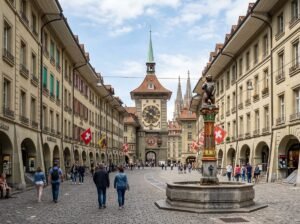
Murten’s medieval walls are so well preserved that you can walk the complete circuit on the elevated wall-walk. The old town inside is picturesque: arcaded streets, a castle, and a market square that hosts one of Switzerland’s best Christmas markets. Lake Murten adds beautiful waterside promenades.
14. Gruyères – Cheese, Château, and H.R. Giger
Gruyères is the village that gave the world its most famous cheese – but the medieval hilltop town is remarkable in its own right. The 13th-century château offers exceptional views; the town center is perfectly preserved. The unexpected highlight: the H.R. Giger Museum, dedicated to the Swiss artist who designed the Alien, housed in a medieval castle just below the village. The juxtaposition is very Swiss.
15. Stein am Rhein – Medieval Perfection
Stein am Rhein on the Rhine is arguably Switzerland’s most perfectly preserved medieval town – the main square (Rathausplatz) is lined with 16th-century half-timbered buildings entirely covered in painted murals depicting the histories of their occupants. The detail and quality of preservation is extraordinary. For more information, check out plan your European adventure.
Compare thousands of hotels with free cancellation options.
How to Plan Your Swiss Village Trip 2026
- Swiss Travel Pass: Covers unlimited travel on trains, buses, and boats between villages. Essential for multi-village trips. 4-day pass from CHF 244
- Book accommodation early: Mountain village hotels sell out months in advance for summer (July-August) and Christmas/New Year
- Layer up: Alpine weather changes rapidly. Even in summer, temperatures can drop to 5°C at altitude
- Cash is useful: Many mountain restaurants and smaller village shops prefer cash
- Hiking gear: Good walking boots are essential for Bernese Oberland and Valais villages
- Photo timing: Golden hour (sunrise and sunset) transforms Alpine villages – rise early for empty streets and optimal light
External reference: MySwitzerland.com – Official Swiss Tourism
Complete Swiss Travel Pass guide and tips →
Getting Between Swiss Villages
Switzerland’s public transport network is the world’s best – connecting even tiny mountain villages with clockwork precision.
- SBB trains: Connect major valley towns and villages. Reserve seats on busy routes in summer
- Cog railways (Zahnradbahn): Serve car-free mountain villages – Grindelwald-Wengen, Mürren-Lauterbrunnen
- PostBus: Yellow PostBus network reaches villages trains don’t. Schedules are reliable to the minute
- Cable cars (Seilbahnen): Connect valley villages to alpine terrain. Swiss Travel Pass covers many
- Lake boats: Serve Lucerne, Brienz, Thun, Geneva, and Lugano lakeside villages
External reference: SBB Swiss Federal Railways – Train and Pass Information
Our Methodology
Anna Fischer has lived in Switzerland for 18 years and visited all 15 villages in this guide multiple times across different seasons. This guide was updated in March 2026 with current visitor information, transportation details, and practical tips verified in winter 2025/2026. Village selection prioritized authenticity, visual appeal, accessibility, and the overall visitor experience – not commercial arrangements or sponsor relationships.
Editorial Disclosure: SwitzerlandVibe may earn affiliate commissions on bookings made through our links. Our village recommendations are entirely independent of commercial partnerships.
FAQ
What are the most beautiful villages in Switzerland?
The most beautiful Swiss villages for scenery: Mürren (clifftop, car-free, Jungfrau views), Saas-Fee (glacier village, 13 four-thousanders), Grindelwald (Eiger backdrop), Lauterbrunnen (waterfall valley). Most distinctive architecturally: Appenzell (painted facades), Guarda (sgraffito Engadine houses), Stein am Rhein (painted murals), Gruyères (medieval hilltop).
What is the most picturesque village in Switzerland?
Mürren consistently tops readers’ and travel writers’ rankings as Switzerland’s most picturesque village. The combination of car-free atmosphere, clifftop setting above the Lauterbrunnen valley, and the unobstructed view of the Eiger, Mönch, and Jungfrau creates an Alpine perfection that is genuinely hard to surpass.
When is the best time to visit Swiss villages?
Summer (mid-June to mid-September): wildflowers, hiking, warm days, all facilities open. Winter (December-March): skiing, Christmas markets, snow-covered chalets. Shoulder seasons: May (spring flowers, fewer crowds) and October (autumn colors, excellent light for photography). Each season offers a completely different – and equally compelling – experience.
Are Swiss villages expensive to visit?
Yes – Switzerland is among Europe’s most expensive countries. Budget: CHF 100-150/day with hostel accommodation and self-catering. Mid-range: CHF 200-300/day with 3-star hotel and restaurant lunches. The Swiss Travel Pass (from CHF 244 for 4 days) saves significantly on transport costs and is essentially mandatory for multi-village exploration.
What is the best Swiss village for hiking?
Grindelwald and Mürren are best for alpine hiking (Bernese Oberland trail network, Eiger Trail, Jungfraujoch). Zermatt offers 400km of trails with the Matterhorn in constant view. Appenzell’s Alpstein region combines beautiful rolling hills with dramatic Santis peak access. Saas-Fee offers glacier hiking. The choice depends on whether you prefer dramatic peaks or rolling pastoral scenerys.
Related Reading
- Switzerland Hidden Gems: 15 Secrets (2026)
- Switzerland on a Budget: How to Save Money (Local Tips)
- Swiss Transport Secrets: Travel for Less
Editorial standards
Why trust this guide
- Route-checked. Itineraries, transfers and timings are verified against current public-transport schedules and operator pages.
- Honest comparisons. Hotel areas and tours are compared on real value — affiliate links never change the recommendation.
- Transparent. Some links are affiliate links; the disclosure is shown on every guide.
This guide is informational travel content, not professional travel, financial or legal advice. Always confirm prices, opening times and conditions with the official provider before you book.