Switzerland ranks among the top 5 most-visited countries in Europe, attracting over 12 million international tourists annually. With 208 peaks above 3,000 meters, four national languages, and a rail system rated the best in the world, planning a trip here can feel overwhelming. This guide covers the best places to visit in Switzerland in 2026, organized as a logical road trip route that minimizes backtracking and maximizes variety.
Whether you drive, take trains, or combine both, this itinerary works over 7 to 14 days depending on your pace. Each stop deserves at least one overnight stay.
What Are the Best Places to Visit in Switzerland in 2026?
The best places to visit in Switzerland in 2026 include Zurich, Lucerne, the Jungfrau region, Zermatt, Montreux, Bern, and Basel. Each destination offers a distinct experience — from medieval old towns and glacial lakes to world-famous peaks and vineyard-covered hillsides.
This six-stop itinerary follows a circular route starting and ending near major airports. You will cross three language regions (German, French, and Italian-influenced areas) and experience the full range of what makes Switzerland one of Europe’s most rewarding travel destinations.
| Stop | Destination | Highlights | Recommended Days |
|---|---|---|---|
| 1 | Zurich | Old town, Lake Zurich, museums | 1-2 |
| 2 | Lucerne | Chapel Bridge, Mount Pilatus, lake | 2 |
| 3 | Interlaken / Jungfrau | Jungfraujoch, Lauterbrunnen, hiking | 2-3 |
| 4 | Zermatt | Matterhorn, Gornergrat, Five Lakes Trail | 2 |
| 5 | Montreux / Lake Geneva | Chateau de Chillon, Lavaux vineyards | 1-2 |
| 6 | Bern | UNESCO old town, Aare swimming, Einstein Museum | 1-2 |
How Should You Start Your Trip in Zurich?
Zurich is the natural starting point for most Swiss road trips. It is the country’s largest city and home to the busiest international airport. Most travelers arriving from North America, Asia, or the Middle East land here.
Zurich combines a well-preserved medieval old town (Altstadt) with world-class museums like the Kunsthaus and the Swiss National Museum. The Niederdorf quarter offers narrow cobblestone streets lined with cafes and boutiques. Lake Zurich stretches south from the city center, and public Badis (swimming spots) along the shore are free to use during summer months.
For panoramic views, take the S10 train to Uetliberg (20 minutes from the main station). The hilltop lookout covers the entire city, the lake, and on clear days, the Alps.
What to eat: Zurcher Geschnetzeltes — sliced veal in cream sauce served with rosti (crispy grated potatoes). Most traditional restaurants in the old town serve it for CHF 30-45.
Drive to next stop: Zurich to Lucerne takes 50 minutes by car or 46 minutes by direct train.
Why Is Lucerne Considered Switzerland’s Most Photogenic City?
Lucerne earns its reputation through a combination of medieval architecture, mountain access, and lake setting that few European cities can match. The Chapel Bridge (Kapellbrucke), built in 1333, is the oldest covered wooden bridge in Europe. Its interior panels display 17th-century paintings depicting local history.
The old town’s painted facades, the dramatic Lion Monument carved into rock, and the waterfront promenade along Lake Lucerne (Vierwaldstattersee) create a setting that looks staged but is entirely real. Behind the city, mountains rise steeply — and you can reach their summits by cogwheel train or cable car.
Top excursion: The Golden Round Trip to Mount Pilatus combines a boat ride across the lake, the steepest cogwheel railway in the world (48% gradient), and a cable car descent. The full circuit takes about 5.5 hours and costs CHF 72 with a Swiss Half Fare Card.
Alternative: Mount Rigi, accessible by boat and cogwheel train, offers easier hiking and fewer crowds than Pilatus. The Swiss Travel Pass covers the entire Rigi journey at no extra cost.
Drive to next stop: Lucerne to Interlaken takes 1 hour 15 minutes via the Brunig Pass, one of Switzerland’s most scenic drives.
What Makes the Jungfrau Region Worth Multiple Days?
The Jungfrau region surrounding Interlaken contains Switzerland’s most dramatic mountain scenery. Three peaks — Eiger (3,967m), Monch (4,107m), and Jungfrau (4,158m) — form a wall of rock and ice visible from the valley floor. Below them, the Lauterbrunnen Valley drops between vertical cliffs with 72 waterfalls, a setting that inspired Tolkien’s description of Rivendell.
Interlaken sits between Lake Thun and Lake Brienz at 564 meters elevation. From here, mountain railways and gondolas fan out to high-altitude viewpoints and trailheads.
Jungfraujoch (“Top of Europe”): The train to Jungfraujoch station at 3,454 meters is expensive (CHF 200+ return, CHF 105 with Half Fare Card) but puts you on a glacier surrounded by 4,000-meter peaks. The Sphinx observation deck and the Ice Palace carved inside the glacier are included. Book early morning departures — afternoon clouds often block the views.
Budget alternative: The Mannlichen-to-Kleine Scheidegg trail (1.5 hours, mostly flat) puts the Eiger North Face directly in front of you. The gondola to the trailhead costs CHF 37 with Half Fare Card. This is widely considered one of the best easy hikes in the Alps.
Lauterbrunnen Valley: Free to explore on foot. Staubbach Falls (297m) drops almost vertically beside the village. Trummelbach Falls (CHF 15 entry) consists of ten glacier waterfalls inside the mountain, accessible by tunnel lift.
Drive to next stop: Interlaken to Tasch takes 2 hours 30 minutes. From Tasch, a shuttle train (12 minutes, CHF 16.40 return) brings you to car-free Zermatt.
How Do You Experience the Matterhorn in Zermatt?
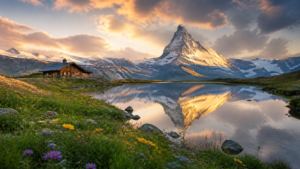
Zermatt exists because of the Matterhorn, arguably the most recognizable mountain on Earth. The car-free village sits at 1,620 meters, surrounded by 29 peaks above 4,000 meters — the highest concentration in the Alps. Electric taxis and horse-drawn carriages handle local transport.
The Gornergrat Railway, running since 1898, climbs to 3,089 meters in 33 minutes. The summit panorama includes the Matterhorn, Monte Rosa (4,634m, the highest peak in Switzerland), and the Gorner Glacier. Return tickets cost CHF 98 (CHF 49 with Half Fare Card). The first train of the day offers sunrise views with far fewer visitors.
Best hike: The Five Lakes Trail (5-Seen-Wanderung) connects five alpine lakes, each reflecting the Matterhorn from a different angle. The trail starts from Blauherd station (reached by gondola from Zermatt) and covers 9.5 km in about 2.5 hours. Difficulty is moderate with some rocky sections.
Year-round skiing: The Matterhorn Glacier Paradise (Klein Matterhorn) at 3,883 meters offers skiing every month of the year. A day pass costs around CHF 92.
Village tip: Walk through the old Hinterdorf quarter to see traditional Valais granaries — dark-wood structures raised on mushroom-shaped staddle stones to keep rodents out. Some date back over 500 years.
Compare flights to Switzerland on Trip.com to find the best prices for your trip.
Drive to next stop: Tasch to Montreux takes 2 hours 30 minutes through the Rhone Valley.
What Can You See Along Lake Geneva and the Swiss Riviera?
The Swiss Riviera along Lake Geneva (Lac Leman) feels Mediterranean compared to the rest of Switzerland. Palm trees, mild winters, and vineyard-covered slopes characterize this region. Montreux, Vevey, and Lausanne sit along the northern shore with the French Alps visible across the water.
Chateau de Chillon: Built on a rocky island at the lake’s edge, this medieval castle has stood since the 12th century. Lord Byron wrote about it in 1816, and his signature is still visible in the dungeon. Entry costs CHF 13.50. It is Switzerland’s most visited historic building.
Lavaux Vineyards: Between Montreux and Lausanne, the Lavaux vineyard terraces cascade down steep slopes to the lake. This UNESCO World Heritage site dates to the 11th century when Benedictine monks first cultivated the slopes. Walk the marked trail (about 11 km point-to-point) and stop at a caveau (wine cellar) to taste Chasselas, the region’s signature white grape.
Lake cruises: Belle Epoque paddle steamers, some over 100 years old, operate regular routes across the lake. The Montreux-to-Geneva route takes about 4.5 hours and is covered by the Swiss Travel Pass. These ships are floating museums with restored wood interiors and working steam engines.
Find affordable rental cars for your Swiss road trip with GetRentacar and explore at your own pace.
Drive to next stop: Montreux to Bern takes 1 hour 30 minutes.
Why Is Bern One of Europe’s Most Underrated Capitals?
Bern, Switzerland’s federal capital since 1848, surprises most visitors. Unlike Zurich or Geneva, Bern rarely appears on “top cities” lists — yet its entire old town is a UNESCO World Heritage Site. The city sits on a peninsula formed by a bend in the Aare River, with medieval sandstone buildings, 6 kilometers of covered arcades (Lauben), and a pace of life far calmer than other capitals.
The Zytglogge, a 13th-century clock tower, performs a mechanical show four minutes before every hour. Bears — the city’s heraldic animal — live in the open-air BearPark along the river. The Einstein Museum occupies the apartment where Albert Einstein developed his theory of special relativity in 1905.
Summer highlight: Swimming in the Aare River is a local tradition. The turquoise glacial water flows at a strong current through the old town, and locals float downstream for 1-2 km before climbing out at designated exit points. Water temperature reaches 18-20 degrees Celsius in July and August.
Rosengarten: The Rose Garden, on a hill above the old town, offers the best panoramic view of Bern’s medieval skyline. Free entry. Over 200 rose varieties bloom from May through October. For more information, check out top European destinations.
Markets: The Bundesplatz (Parliament Square) hosts a produce market on Tuesdays and Saturdays. In November and December, it transforms into one of Switzerland’s largest Christmas markets.
Search for the best flight deals to Switzerland on Aviasales and start planning your road trip.
How Much Does a Switzerland Road Trip Cost in 2026?
Switzerland is consistently ranked as Europe’s most expensive country for travelers. Planning your budget before departure prevents surprises. Here is a realistic breakdown for 2026.
| Budget Level | Daily Cost (per person) | Accommodation | Food | Activities |
|---|---|---|---|---|
| Budget | CHF 120-160 | Hostels, camping | Supermarket meals | Free hiking, city walks |
| Mid-range | CHF 250-350 | 3-star hotels | Restaurant lunches, self-catering dinners | 1-2 mountain excursions |
| Comfortable | CHF 400-600+ | Boutique hotels | Full restaurant dining | Premium activities, spa |
Key savings strategies:
- Swiss Half Fare Card (CHF 120 for one month): Halves the price of trains, buses, boats, and most mountain railways. Pays for itself in 1-2 excursions.
- Supermarkets: Migros and Coop offer quality prepared meals for CHF 8-12. Restaurant meals average CHF 25-40.
- Free activities: Hiking is free once you reach the trailhead. Swimming in lakes and rivers costs nothing. Many city museums offer free entry on the first Sunday of each month.
- Shoulder season (May-June, September-October): Hotel rates drop 20-30% compared to July-August peak.
What Documents and Passes Do You Need for Driving in Switzerland?
A motorway vignette (CHF 40, valid January to January) is required for all vehicles using Swiss motorways. Since 2023, an electronic vignette (e-vignette) is available through the Federal Customs Administration website, so you no longer need the physical sticker. Driving without a valid vignette results in a CHF 200 fine plus the vignette cost.
EU and US driving licenses are valid in Switzerland. An International Driving Permit is recommended for licenses not in German, French, or Italian. Speed limits are 120 km/h on motorways, 80 km/h outside towns, and 50 km/h in urban areas. Radar enforcement is strict — fines start at CHF 40 and increase sharply above 20 km/h over the limit.
Mountain pass status: Major passes like the Grimsel, Furka, and Susten typically open between May and October depending on snow conditions. Check TCS (Touring Club Switzerland) for real-time pass status before planning detours through high-altitude routes.
Frequently Asked Questions
How many days do I need for a Switzerland road trip?
This six-stop itinerary works best with 7 to 10 days: 1 to 2 days per major stop plus driving time. A rushed version is possible in 5 days, but you will miss the mountain excursions that define the Swiss experience. For a complete tour including Appenzell, the Engadin Valley, and Ticino, plan 14 to 18 days. If time is limited, prioritize Lucerne and the Jungfrau region — they deliver the most concentrated Swiss experience.
Should I drive or take trains in Switzerland?
Both options work well. Swiss trains are punctual, scenic, and cover even remote villages. The Swiss Travel Pass (from CHF 232 for 3 consecutive days) includes unlimited travel on trains, buses, and boats plus free museum entry. Driving offers flexibility for remote valleys and spontaneous stops, but parking in cities costs CHF 25-40 per day and several destinations (Zermatt, Murren, Wengen) are car-free. The best approach for most travelers: rent a car for rural sections and use trains between cities.
What is the best time of year to visit Switzerland?
June through September offers the best conditions overall. Mountain passes are open, hiking trails are snow-free, lakes are warm enough for swimming, and daylight lasts until 9 PM. July and August are warmest but most crowded. September and October bring autumn colors, clearer mountain views, and fewer tourists. Winter (December through March) is ideal for skiing but limits mountain driving. Spring (April and May) is unpredictable — valleys bloom while higher elevations may still have snow.
Is Switzerland safe for solo travelers?
Switzerland consistently ranks among the safest countries in the world. Violent crime rates are extremely low, public transport runs reliably even at night, and hiking trails are well-marked and maintained. Solo female travelers report feeling safe throughout the country. The main practical concern is cost rather than safety. Emergency number: 112 (universal European emergency line) or 117 (police).
Can I use euros in Switzerland?
Switzerland uses the Swiss franc (CHF). Euros are accepted at some tourist shops, hotels, and train stations, but always at an unfavorable exchange rate. You will receive change in Swiss francs. ATMs are widely available and offer better rates. Credit cards (Visa, Mastercard) are accepted almost everywhere, including small mountain restaurants. Notify your bank before traveling to avoid card blocks.
What languages are spoken in Switzerland?
Switzerland has four national languages: German (63% of the population), French (23%), Italian (8%), and Romansh (0.5%). English is widely spoken in tourist areas, hotels, and restaurants. In German-speaking regions, locals speak Swiss German (Schwyzerdutsch) in daily life, which differs significantly from standard German. Signs, menus, and official information are always available in the local official language, and often in English in tourist zones.
How do I get from the airport to the city center?
Zurich Airport connects to Zurich main station (Hauptbahnhof) in 12 minutes by direct train, running every 5-10 minutes. Geneva Airport has a train station inside the terminal with connections to Geneva city center in 7 minutes. Both airports also serve as starting points for trains to any destination in Switzerland. A free ticket for Geneva public transport is available at luggage claim machines, valid for 80 minutes.
Sources:
– Switzerland Tourism (MySwitzerland.com) — Official national tourism board
– Swiss Federal Railways (SBB) — Train schedules, passes, and fares
– TCS Touring Club Switzerland — Driving information, road conditions, and pass status
Written by Anna Berger, Swiss tourism writer specializing in budget travel and alpine destinations. Anna has covered Switzerland for over 8 years, visiting every canton and testing routes for independent travelers. Last updated: April 2026.
Disclaimer: This article contains affiliate links. If you book through these links, we may earn a small commission at no extra cost to you. This helps support SwitzerlandVibe and allows us to continue creating free travel guides. All recommendations are based on independent research and personal experience.
Editorial standards
Why trust this guide
- Route-checked. Itineraries, transfers and timings are verified against current public-transport schedules and operator pages.
- Honest comparisons. Hotel areas and tours are compared on real value — affiliate links never change the recommendation.
- Transparent. Some links are affiliate links; the disclosure is shown on every guide.
This guide is informational travel content, not professional travel, financial or legal advice. Always confirm prices, opening times and conditions with the official provider before you book.