title: “Switzerland Winter Travel Guide 2026: Top 7 Enchanting Spots”
slug: “switzerland-winter-travel-guide-2026”
domain: “switzerlandvibe.com”
primary_keyword: “switzerland winter travel guide 2026”
date: 2026-06-13
word_count: 2780
status: draft
author: “Anna Berger”
schema:
– Article
– FAQPage
– Author
Disclosure: This article contains affiliate links. If you book through our recommended partners, we may earn a commission at no extra cost to you. We only recommend services we consider worth the price.
Switzerland Winter Travel Guide 2026: Top 7 Enchanting Spots
Switzerland in winter is a different country from the one tourists see in July. The alpine villages go quiet, prices at mountain hotels drop from summer peaks, and the light on snow-covered peaks at 4pm is unlike anything you will find in warmer months. This guide covers seven destinations that reward winter visits with precision: what to do there, how to get there by train, what it costs, and where the value is genuine.
Whether you ski or not, December through February in Switzerland is worth planning carefully. Here is how.

How to Plan Your Switzerland Winter Trip: The Basics
Start with transport. Switzerland’s rail network runs on time to the minute, and in winter it is the safest and most scenic way to reach mountain villages. A Swiss Travel Pass review covers unlimited trains, PostBuses, lake boats, and city trams across 90+ towns. In 2nd class, the pass starts at CHF 254 for 3 consecutive days and CHF 405 in 1st class for the same period, based on 2026 pricing from SBB. Children under 16 travel free with a parent using the Swiss Family Card.
The pass also gives 25 to 50% discount on most mountain railways. Given that a single return cable-car ride (for example, Lucerne to Pilatus Kulm) costs around CHF 60 without discount, the pass pays back quickly on a week-long itinerary.
When to visit: December through February. Late November catches the Christmas markets before crowds peak. January is quieter and colder. February is peak ski season but also the most reliably snow-covered period across all altitudes.
What to budget: Switzerland is not cheap. A mid-range hotel in a mountain village runs CHF 150 to 280 per night. Meals at a proper restaurant cost CHF 25 to 45 per main. Plan for CHF 180 to 250 per person per day all-in, excluding ski passes.

1. Zermatt: The Alps Without Cars
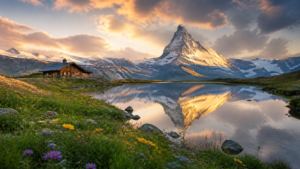
Zermatt is the best Swiss winter destination for car-free alpine scenery and year-round high-altitude skiing. It sits at 1,620 metres in the canton of Valais, at the foot of the Matterhorn, and the absence of combustion engines is the first thing you notice. Electric taxis and horse-drawn carriages move people between the station and hotels. The air is clean in a way that feels deliberate.
Why Zermatt in Winter
The Matterhorn is visible on clear days from the village centre, and in winter the peak is snow-capped and striking. The skiing here covers 360 km of marked runs across three connected areas: Zermatt, Cervinia (Italy), and Valtournenche. A 6-day Zermatt ski pass costs CHF 408 per adult [ESTIMATION: verify current season pricing at matterhornparadise.ch].
Non-skiers have equally good options. The 5 Seenweg (Five Lakes Trail) becomes a winter walking path in sections. The Gornergrat rack railway runs year-round and delivers panoramic views of 29 four-thousand-metre peaks from 3,089 metres. A return ticket costs approximately CHF 94 without Swiss Pass discount.
How to Get There
From Zurich: ICE/IC train to Visp (2h 20min), then Matterhorn Gotthard Bahn to Zermatt (1h 20min). Total: around 3h 40min. From Geneva: train to Visp (2h), then to Zermatt (1h 20min). Book through SBB.ch for precise timetables.
Best Pick for Booking
Trip.com lets you book Zermatt hotels, flights into Geneva or Zurich, and package combinations in a single transaction. For Zermatt specifically, it aggregates boutique properties alongside larger hotels, which is useful when you want a specific neighbourhood (the village centre versus quieter outskirts near the ski lifts). The price comparison across dates is clear and the cancellation terms are visible before checkout.
Alternatives worth checking: Booking.com has a wider selection of budget guest houses. Hotellook aggregates prices across multiple booking platforms if you want a price-check.
2. Grindelwald: The Eiger Backyard
Grindelwald is the top choice for Jungfrau region access, combining iconic Eiger views with easier budget options than Zermatt. It sits 40 minutes from Interlaken by train, directly below the north face of the Eiger. See our full Grindelwald travel guide for a deeper look at this valley. The First ski area offers one of the most scenic runs in the Bernese Oberland, and the village is more accessible to families than its more exclusive rival.
Why Grindelwald in Winter
The gondola to First (2,168m) gives access to the First Cliff Walk, a suspension walkway bolted into the cliff face. In winter it is open, free to walk, and almost always deserted by 9am. The views of the Wetterhorn and Schreckhorn are direct and close.
The Jungfraujoch (Top of Europe) train station at 3,454m is reachable from Grindelwald station via Kleine Scheidegg. A return ticket costs CHF 226.80 for adults (2026 pricing, jungfrau.ch). Swiss Travel Pass holders get a 25% discount. On clear days, the Aletsch Glacier is visible, the longest in the Alps at 23 km.
Practical Notes
Grindelwald has a real village infrastructure: pharmacies, supermarkets, multiple restaurants. The train from Interlaken Ost runs every 30 minutes. In deep winter (January), temperatures drop to -8C at village level and -20C on the Jungfraujoch. Layer accordingly: base layer, mid fleece, waterproof shell.
How to Get There
From Zurich: IC train to Interlaken Ost (2h), then Bernese Oberland Bahn to Grindelwald (35min). Total: around 2h 40min.

3. St. Moritz: Alpine Luxury That Justifies the Cost
St. Moritz is best for luxury travellers and serious skiers who want the prestige of the Engadin valley. Located in the canton of Graubunden at 1,856 metres, its reputation is accurate. The town is home to two Olympic bobsleigh tracks and has hosted the Winter Olympics twice (1928 and 1948). It attracts a clientele that expects quality, and the infrastructure delivers.
Why St. Moritz in Winter
The Engadin ski region connects St. Moritz to Pontresina, Celerina, and Silvaplana across 350 km of runs. The Corviglia ski area above town is the most accessible, reachable by funicular from the town centre. A 6-day ski pass for the Engadin-St. Moritz area costs around CHF 390 [ESTIMATION: check engadin.ch for 2026-27 season pricing].
Beyond skiing: the Engadin lake chain (St. Moritzersee, Silvaplanersee) freezes solid enough in January and February for ice skating, kite skiing, and the Engadin Nordic Ski Marathon (a 42 km cross-country race held annually in March, attracting 12,000+ participants according to engadin.ch).
The Segantini Museum on the hill above town houses the largest collection of Giovanni Segantini’s alpine paintings. Entry costs CHF 15. It is one of the better small museums in the Alps for context on how this landscape was perceived before mass tourism.
How to Get There
From Zurich: Bernina Express or direct IC to Chur (1h 10min), then Rhaetian Railway to St. Moritz (2h). Total: around 3h 15min. The Rhaetian Railway through the Albula gorge is a UNESCO World Heritage rail route.
4. Lucerne: Winter Without Skis
Lucerne is the best base for travellers who want Swiss winter scenery without skiing. The old town, Kapellbrucke (Chapel Bridge), and lake promenade are walkable year-round. In December, the Christmas markets at Franziskanerplatz and the craft market at Muhlenplatz run until December 24.
Why Lucerne in Winter
Mount Rigi (1,797m) is reachable from Lucerne by lake boat and rack railway in under two hours. In winter, the summit is often above the cloud inversion, giving views of fog-covered lowlands with peaks above. A return ticket to Rigi Kulm costs CHF 72 per adult (Vitznau route) without discount.
Mount Pilatus, another Lucerne day trip, is accessible in winter via cable car from Kriens. The Pilatus Kulm hotel at the summit is open in winter for lunch. Return cable car: CHF 60.50 per adult without discount.
The GoldenPass Panoramic line connects Lucerne to Interlaken and continues to Montreux through the Simmental valley. The full route takes about 3.5 hours. In winter, the carriages pass through snow-covered farmland and frozen lakes. It is one of the most scenic train journeys in central Europe for the effort required.
Practical Notes
Lucerne hotels are less expensive than mountain resorts. A well-positioned 4-star property in the old town runs CHF 150 to 200 per night in January. The city is easy to navigate on foot. Restaurants in the old town serve Lucerne-specific dishes: Luzerner Chugeli-Pastete (a puff pastry filled with veal and mushrooms) and various raclette variations.
5. Bern: The Capital in Winter Light
Bern, the Swiss federal capital, is undervisited in winter. The old town is a UNESCO World Heritage site, built across a natural peninsula in the Aare river. The sandstone arcades (Lauben) run for 6 km through the city and mean you can walk the full centre without an umbrella regardless of weather.
Why Bern in Winter
The Munsterplatz Christmas market runs from late November to December 24, with 80+ wooden stalls. For a full roundup of festive markets across the country, see our Switzerland Christmas markets guide. The Sternenmarkt (Star Market) along Europapromenade runs from November 20 to December 28. Both operate regular hours (generally 10:00 to 20:00, check bern.com for 2026 dates).
The Bern Historical Museum holds the Einstein Museum on its lower floors. Entry is CHF 16. The Zentrum Paul Klee on the outskirts of the city is one of the finest artist museums in Switzerland, with 4,000 works by Paul Klee. Entry costs CHF 20 (Swiss Travel Pass covers free entry to 500+ museums, including this one).
The Rosengarten (Rose Garden) above the old town gives a panoramic view of the Aare bend and the old city. In winter, the park is empty. The light is good between 10am and 2pm.
How to Get There
From Zurich: direct IC train, 55 minutes. From Geneva: direct IC, 1h 55min. Bern works as a half-day excursion from Zurich or as a dedicated overnight, which gives more time for the museums and the cathedral.
6. Montreux: Lakeside Winter With Mountains Behind
Montreux sits on the north shore of Lake Geneva (Lac Leman) in the canton of Vaud. The microclimate here is milder than most Swiss cities at the same altitude. Palm trees grow along the lakeside promenade. In winter, snow is rare at lake level but visible on the peaks directly above.
Why Montreux in Winter
The Montreux Noel Christmas market is consistently ranked among the best in Switzerland. It runs from late November through December 25 along the lakeside and at the Chillon Castle grounds. The medieval-themed section at Chateau de Chillon (a 12th-century island castle, CHF 14 entry) is the most photographed element.
The Rochers de Naye summit (2,042m) above Montreux is reachable by rack railway and in winter the platform gives views over Lake Geneva and, on clear days, the Mont Blanc range. Round trip: CHF 55.60 with Swiss Pass discount applied [ESTIMATION: confirm at mob.ch].
The Train des Vignes (Vineyard Train) connects Montreux to Vevey through the Lavaux vineyard terraces, a UNESCO World Heritage wine region. In winter, the vines are bare but the lake views are unobstructed. The ride takes 12 minutes and costs a few francs with a Swiss Pass.
How to Get There
From Geneva: direct train, 1h. From Zurich: IC to Lausanne (2h 10min), then regional train to Montreux (20min). Montreux connects directly to Interlaken via the GoldenPass line.
7. Verbier: For Skiers Who Want Performance Over Prestige
Verbier is in the canton of Valais, at 1,500m, and connects to the Quatre Vallees ski network, the largest ski area in Switzerland at 410 km of runs. It is less polished than St. Moritz and more skier-focused. The clientele is international and younger on average.
Why Verbier in Winter
The Mont Fort at 3,328m is accessible by telecabine and gives access to off-piste terrain that is among the most demanding in the Alps. For strong intermediate and advanced skiers, the combination of altitude, north-facing slopes, and consistent snow record between December and April is the main argument.
A 6-day ski pass for the Quatre Vallees costs approximately CHF 420 per adult [ESTIMATION: verify at verbier.ch for 2026-27 season]. Non-skiers get less return than at Zermatt or Grindelwald: the village is more spread out and less walkable.
How to Get There
From Zurich: IC to Martigny (2h 20min), then bus or private transfer to Verbier (45min). No direct train to Verbier itself. The bus runs regularly from Martigny station and costs around CHF 20 per person each way.
Switzerland Winter Travel: Practical Logistics Table
| Destination | Canton | By Train From Zurich | Ski Access | Best For |
|---|---|---|---|---|
| Zermatt | Valais | ~3h 40min | Yes (360 km) | Scenic, car-free village |
| Grindelwald | Bern | ~2h 40min | Yes (Jungfrau region) | Families, Eiger views |
| St. Moritz | Graubunden | ~3h 15min | Yes (350 km) | Luxury, culture |
| Lucerne | Lucerne | direct, ~55min | No (day trips) | Non-skiers, city base |
| Bern | Bern | ~55min | No | Culture, architecture |
| Montreux | Vaud | ~2h 30min | Limited | Lake, Christmas markets |
| Verbier | Valais | ~3h 10min | Yes (410 km) | Advanced skiers |
Best Pick: How to Book Your Switzerland Winter Trip
For booking hotels, trains, and flights in a single interface with transparent cancellation policies, Trip.com is the recommended starting point. The platform covers Swiss hotels across all seven destinations listed above, lets you filter by cancellation policy, and shows real-time availability for the dates you need.
Why it works for Switzerland specifically:
- Swiss mountain hotels often block off minimum-stay requirements (3 to 5 nights) in peak season. Trip.com shows these filters clearly.
- The price calendar view lets you compare adjacent weeks to find the best rate, which is useful given how sharply Swiss hotel prices shift between weekdays and weekends.
- Flight and hotel combinations for Zurich or Geneva entry reduce the coordination overhead if you are travelling from outside Europe.
For comparison, Booking.com has more guest-house inventory at the budget end. Hotellook is worth a check if you have a specific property in mind and want to confirm you are getting the best available rate across platforms.
Book mountain accommodation early. Zermatt and Verbier fill January and February dates 3 to 4 months in advance for quality properties.
Switzerland Winter Packing Checklist
- Thermal base layers (merino wool preferred for odour control on multi-day trips)
- Waterproof shell jacket and trousers (non-negotiable above 1,500m)
- Insulating mid-layer (down or synthetic)
- Waterproof boots with ankle support
- Sunglasses and sunscreen (UV intensity at altitude is high even in winter)
- Swiss Travel Pass or pre-loaded SBB app
- European plug adapter (type J, unique to Switzerland)
- Health insurance documentation and EHIC card if EU resident
FAQ: Switzerland Winter Travel 2026
Is Switzerland worth visiting in winter if I do not ski?
Yes. Lucerne, Bern, and Montreux each deliver winter experiences that have nothing to do with ski lifts. The Christmas markets in Bern and Montreux rank among the best in Europe. The train network means you can reach scenic viewpoints (Rigi, Pilatus, Rochers de Naye) without skis.
What is the cheapest month to visit Switzerland in winter?
January is typically the lowest-demand month after the Christmas and New Year period (which ends around January 6). Hotel rates drop, restaurants are quieter, and mountain lifts are less crowded. February brings peak ski season demand again.
Is the Swiss Travel Pass worth buying for a winter trip?
If your itinerary includes three or more train journeys between cities and at least one mountain railway excursion with a discount, the pass covers its cost. For a 7-day trip covering Zurich, Lucerne, Bern, and Zermatt, the pass is worth it. For a 3-night stay concentrated in one location, point-to-point tickets are more efficient. The SBB fare calculator lets you compare both options before buying.
How cold does it get in Switzerland in winter?
At lake level (Zurich, Geneva, Lucerne), temperatures range from -3C to 5C in January. At village level in ski resorts (Zermatt at 1,620m, Grindelwald at 1,034m), expect -10C to 0C. On summit platforms above 2,500m, factor in wind chill bringing effective temperatures to -20C or lower.
Do I need to book ski passes in advance?
For January and February, yes. Zermatt and the Jungfrau region in particular see weekend queues at lift pass offices. Most resorts now offer online pre-purchase with a 5 to 10% discount. Booking 4 to 6 weeks ahead is sufficient for most dates.
Editorial standards
Why trust this guide
- Route-checked. Itineraries, transfers and timings are verified against current public-transport schedules and operator pages.
- Honest comparisons. Hotel areas and tours are compared on real value — affiliate links never change the recommendation.
- Transparent. Some links are affiliate links; the disclosure is shown on every guide.
This guide is informational travel content, not professional travel, financial or legal advice. Always confirm prices, opening times and conditions with the official provider before you book.