Disclosure: This article contains affiliate links. If you book through them, switzerlandvibe.com may earn a commission at no extra cost to you. All recommendations are based on merit.
Switzerland First Time Visitor Guide: Start Here (2026)
Switzerland costs more than France or Italy. That is simply true. However, most first-time visitors who plan correctly spend far less than they expected and leave wishing they had booked more nights. The difference lies in knowing what to prioritise, which rail pass to buy, and which cities to use as a strategic base.
This Switzerland first time visitor guide provides the exact orientation a first trip requires. We cover which cities to visit and in what order, how the Swiss public transport system works, a realistic daily cost breakdown across three budget levels, the five experiences that define the country, and the most common mistakes that cost people time and money.
Which Cities Should You Prioritise as a First-Timer?
For a first trip, four cities cover Switzerland’s essential character without overloading your schedule. Each serves a different purpose in your itinerary.
Zurich: Your Arrival Hub
Most international flights land at Zurich Airport (ZRH). The city sits in German-speaking Switzerland and connects to every rail line in the country. Zurich is expensive even by Swiss standards, so treat it as a 1- to 2-night stop rather than a permanent base. Walk the Altstadt (old town), take the lake tram to Zurichsee, and eat lunch at one of the Coop restaurant counters for CHF 12-16 to save money. The train from Zurich to Bern takes 58 minutes, and to Lucerne, it is just 47 minutes.
Lucerne: Compact, Scenic, Genuinely Worth Two Days
Lucerne is the city most first-timers picture when they think of Switzerland: the Chapel Bridge over the Reuss river, Mount Pilatus rising directly from the lake shore, and a compact old town you can walk in under 20 minutes. Two nights is enough to see the town and take one mountain excursion, either Pilatus (via the world’s steepest cogwheel railway from Alpnachstad) or Rigi, accessible directly by lake boat. The Swiss Travel Pass covers all lake boats and city transport from Lucerne, which matters because the boats are a transport method here, not just a tourist activity.
Bern: The Capital Nobody Talks About Enough
Bern is the federal capital, a UNESCO World Heritage old town, and one of the most liveable cities in Switzerland. It is also significantly less crowded than Zurich or Lucerne. For a first trip, Bern offers a full day of genuine urban texture: 6 kilometres of arcaded walkways (the Lauben), the Bear Park, the Clock Tower (Zytglogge), and a panoramic view of the Bernese Alps on clear days. Bern also works as a base for day trips west to Gruyeres or east toward Interlaken. Travel time to Interlaken Ost is 55 minutes by train.
Interlaken: The Alps Gateway
Interlaken sits between Lake Thun and Lake Brienz, directly below the Bernese Oberland massif. It is the access point for Grindelwald, Lauterbrunnen, Mürren, and the Jungfraujoch railway (the highest railway station in Europe, at 3,454 metres). One or two nights here covers the best mountain access in the country. The Jungfraujoch excursion costs CHF 195.80 for a 2nd-class return from Interlaken Ost. Swiss Travel Pass holders receive a discount but do not travel free on this specific route.
Is the Swiss Travel Pass Worth the Investment?
This is the question every first-timer needs to answer before booking anything. Getting it wrong in either direction costs CHF 80 to 200 over a trip.
What the Swiss Travel Pass Covers
The Swiss Travel Pass gives unlimited travel on Swiss Federal Railways (SBB) national routes, most private railways, all lake boats, and urban trams and buses in 90 cities. It also provides free entry to over 500 Swiss museums and 50% discounts on most mountain railways (including Pilatus and Rigi). The 2026 prices for a 2nd-class pass start at CHF 244 for 3 consecutive days, rising to CHF 499 for 15 days. First-class costs approximately 60% more.
When the Pass Pays Off
The pass justifies itself quickly for itineraries that include multiple city hops. A single Zurich-Lucerne-Bern-Interlaken circuit with lake boat day trips easily totals CHF 280-320 in individual tickets. Add city trams and the pass breaks even before Day 3. For a detailed analysis including the Half Fare Card alternative, read our full review on the site.
When Point-to-Point Tickets Are Better
If you plan to stay in one city or region for most of your trip, buy individual tickets or use the SBB app (available in English). A Zurich 24-hour city pass costs CHF 8.80, and SBB SuperSaver fares on long routes can be as low as CHF 19. Point-to-point works well for city breaks of 3 nights or fewer, trips focused on one region only, or itineraries with heavy Jungfraujoch and mountain content where the Half Fare Card (CHF 150, valid 1 month) is often the better value.
How Much Does a Trip to Switzerland Cost in 2026?
Switzerland is expensive. The good news is that costs are structured and predictable once you know the system.
Budget Level: CHF 100-150 per day
This assumes hostel dormitory accommodation (CHF 35-55 in major cities), self-catered breakfast, a Coop or Migros supermarket lunch (CHF 10-15), one restaurant dinner using the lunch menu or a set option (CHF 20-30), and a Swiss Travel Pass already purchased for the trip. Free activities include hiking most alpine trails, walking old towns, and swimming in lakes. Coop and Migros are Switzerland’s two main supermarket chains. Both have excellent prepared food counters. A hot meal from the counter costs CHF 8-14 and is the single most effective way to reduce daily food spend without sacrificing quality.
Mid-Range Level: CHF 200-280 per day
Private room in a 3-star hotel or pension (CHF 110-160), restaurant lunch and one dinner (CHF 55-80 combined), Swiss Travel Pass, and one or two paid activities such as a museum or boat excursion. This is the range for the majority of first-time visitors. A mid-range 7-day trip for one person, including transport pass, typically runs CHF 1,500-2,000.
Luxury Level: CHF 400+ per day
Four- and five-star hotels in Zurich, Lucerne, or Grindelwald start at CHF 250-350 per night per room. Fine dining costs CHF 80-150 per person for dinner. First-class Swiss Travel Pass, private mountain excursions, and spa access add further. At this level, Switzerland is simply one of the world’s great destinations for alpine luxury.
What Actually Costs More Than Expected
Two costs reliably surprise first-timers. First, mountain excursions: the Jungfraujoch, Titlis, or Klein Matterhorn add CHF 80-200 per person per day. Second, alcohol: a beer in a Zurich bar costs CHF 7-9, wine by the glass CHF 8-12. Budget for this or focus drinks at hotel bars where costs are sometimes lower.
What Are the Non-Negotiable Experiences for First-Timers?
Not a generic list. These are the five things that explain why people return to Switzerland.
- Take a Scenic Train Journey: Switzerland’s panoramic trains are functional routes, not tourist gimmicks. The Bernina Express connects Chur to Tirano (Italy) across 55 UNESCO-listed bridges and viaducts. The Glacier Express runs the 8-hour Zermatt to St. Moritz route through the high Alps. Seat reservations for the Glacier Express cost CHF 54 in 2nd class; the route itself is free with a Swiss Travel Pass.
- Stay Above 1,500 Metres for at Least One Night: Swiss mountain villages operate differently from valley towns. Mürren (car-free, accessed by cable car from Lauterbrunnen) and Gimmelwald below it are the benchmark examples: no road access, views directly onto the Eiger, Mönch, and Jungfrau, and guesthouses that cost 30-40% less than Grindelwald.
- Walk an Alpine Trail Between Two Villages: Switzerland maintains approximately 65,000 kilometres of marked hiking trails. Most require no specialist equipment beyond decent shoes. The Grindelwald to First hike, the Schilthorn circular, and the Gemmipass trail above Leukerbad are all accessible to moderate-fitness walkers.
- Eat a Proper Fondue or Raclette Dinner: Not at a tourist restaurant in Zurich’s Altstadt. In Bern, Lucerne, or better still a village. Fondue moitié-moitié (Gruyère and Vacherin Fribourgeois) costs CHF 28-38 per person for the cheese course. Raclette, the melted cheese scraped onto potatoes, is even simpler and just as satisfying.
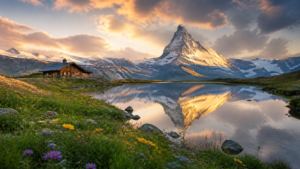
- Sit at a Lake and Do Nothing for an Hour: Brienzersee (Lake Brienz) is the colour comparison point: turquoise-green glacial water against limestone cliffs. Thunersee (Lake Thun) has viewpoints from the town beach where the Bernese Alps sit directly across the water. Lake Lucerne can be toured by boat in 90 minutes.
When Is the Best Time to Visit Switzerland?
Summer (June to August): Peak Season
Advantages: all mountain railways running, maximum daylight (17 hours in June), hiking fully accessible above 2,000 metres. Disadvantages: peak prices across accommodation and attractions, Zurich and Lucerne are crowded, and July-August heat in valleys can be uncomfortably warm (30-35°C in Ticino).
Autumn (September to October): Best Overall Season
September is when the shoulder-season argument is strongest. Alpine larch trees turn gold from mid-September, crowds thin noticeably, accommodation costs drop 15-25%, and hiking conditions remain excellent until mid-October.
Winter (December to March): Ski Season and Christmas
Ski resorts (Verbier, Zermatt, St. Moritz, Grindelwald) operate at full capacity. Christmas markets in Bern, Zurich, Basel, and Montreux are some of the best in Europe. Snow on the ground transforms the terrain entirely.
Spring (March to May): Variable and Underrated
Lower valley floors bloom in April and May while mountains still hold snow. Lake Geneva’s Lavaux vineyards and the Zurich lakeside are at their best. Some mountain lifts do not open until late May or early June.
What Mistakes Do First-Time Visitors Make?
Booking the wrong accommodation location. Staying in Interlaken West when activities depart from Interlaken Ost (different station, 10-minute walk). Staying on Zurich’s outskirts when the tram network makes the old town area better value. Always check which train station serves your next destination.
Underestimating mountain excursion costs. The Swiss Travel Pass does not cover everything above a cable car mid-station. Always check the excursion price specifically. Jungfraujoch, Titlis, and Klein Matterhorn above Zermatt are the main exceptions that cost CHF 100+ even with a pass.
Ignoring the Half Fare Card option. If you are staying mostly in one city, the Half Fare Card (CHF 150 for 1 month) halves the price of every SBB ticket and most mountain railways. For trips under 4 days with limited city-hopping, it outperforms the Swiss Travel Pass on cost.
Over-scheduling. Four cities in 5 days is already a full schedule. Swiss trains run precisely but connections are timed. Missing a transfer does not mean waiting hours, but it does add 30 minutes. Build in one rest day per 4-5 day trip or you will arrive home exhausted.
Editorial standards
Why trust this guide
- Route-checked. Itineraries, transfers and timings are verified against current public-transport schedules and operator pages.
- Honest comparisons. Hotel areas and tours are compared on real value — affiliate links never change the recommendation.
- Transparent. Some links are affiliate links; the disclosure is shown on every guide.
This guide is informational travel content, not professional travel, financial or legal advice. Always confirm prices, opening times and conditions with the official provider before you book.