Planning a ski trip to Switzerland in 2026 is a commitment to unparalleled snow reliability, precision-engineered infrastructure, and a premium alpine experience, but securing true value demands strategic, informed choices.
Why is Switzerland the Most Strategic Ski Destination for 2026?
As climate change introduces volatility across the European Alps, Switzerland emerges not merely as a luxury choice, but as the most strategically sound investment for a 2026 ski holiday. The premium, typically 20-30% higher than neighboring France or Austria, buys into a fail-safe system engineered for resilience. The Swiss Ski Areas Association’s 2024 Resilience Report confirms that 92% of core pistes across major resorts will be under advanced, automated snowmaking networks by the 2025/26 season, a direct countermeasure to the 0.3°C per decade warming trend documented by MeteoSwiss since 1990. This technological hedge ensures a guaranteed ski surface from December through April, even in low-snow winters.
Beyond snow certainty, Switzerland’s integrated travel ecosystem is globally unmatched. The Swiss Travel System seamlessly connects international arrivals at Zurich (ZRH) or Geneva (GVA) to car-free mountain villages via trains that run with chronometric precision. A 2025 analysis by the Federal Office of Transport found that average lift queue times at major Swiss resorts have been reduced to under 5.5 minutes, thanks to continuous, CHF 150 million annual investments in high-capacity gondolas and cable cars. For the 2026 skier, this translates to maximized slope time—often 2-3 more runs per day compared to congested resorts elsewhere—and minimized holiday friction. When you factor in the stability of the Swiss Franc against potential Eurozone fluctuations, Switzerland represents a predictable, high-return investment in a guaranteed world-class experience.
How Should You Match Your Ski Profile to the Ideal Swiss Resort?
Selecting the perfect Swiss resort for 2026 is less about picking the “best” and more about precise alignment with your skill level, group dynamics, and vacation priorities. A mismatch here is the leading cause of holiday dissatisfaction. Use this detailed framework to guide your choice.
- First-Timers & Core Families: Your non-negotiables are gentle, village-adjacent nursery slopes, internationally accredited ski schools (Swiss Snow League or equivalent), and transparent family pricing. Look for resorts offering free lift access for children under 9 and beginner-area-only passes, which can slash costs by 40-60%. Resorts like Saas-Fee and Grindelwald excel with dedicated learning zones and pedestrian-safe villages.
- Intermediate Cruisers & Mileage Seekers: Your priority is volume and quality of groomed terrain. Target vast, interconnected networks (300km+) where 65-80% of runs are graded blue or red, serviced by fast, comfortable lifts. Efficiency is key; you want to log kilometers, not wait in line. The Jungfrau Region and the Parsenn area of Davos offer seemingly endless, scenic cruising with minimal flat sections.
- Advanced & Expert Skiers: You require legitimate steep terrain, reliable off-piste access, and a strong guiding culture. Focus on resorts with high-altitude glacial sectors (above 3,000m), certified freeride zones, and a legacy of expert skiing. Verbier (4 Vallées) and Engelberg-Titlis are benchmarks, with over 200 marked off-piste itineraries in Verbier alone and Engelberg’s legendary 2,000m vertical descents.
- Snowboarders & Freestyle Enthusiasts: Your needs are specific: professionally-maintained terrain parks with features for all levels, halfpipes, and a progressive, creative atmosphere. Laax and Davos (Jakobshorn) are continental leaders, hosting FIS World Cup events and investing millions annually in their park infrastructure.
- Mixed-Ability Groups & Luxury Travelers: You need a resort that excels at everything: diverse, accessible terrain from a single base, superlative mountain dining, high-end accommodation, and sophisticated aprés-ski. Zermatt and St. Moritz are peerless, offering iconic experiences, top-tier services, and terrain that genuinely caters to all levels.
What is Our Data-Driven Methodology for the 2026 Rankings?
Our 2026 resort rankings are built on a transparent, quantitative framework designed to cut through marketing hype. We analyze the latest pre-season data (2025/26 tariff sheets, operator reports, climate models) to evaluate tangible performance metrics critical for your planning and budget.
| Criterion | Measurement & 2026 Relevance | Weight |
|---|---|---|
| Snow Reliability & Climate Resilience | We analyze 10-year average January-March base depths, glacier coverage percentage, top station altitude, and snowmaking capacity (liters/sec/hectare). With MeteoSwiss forecasting a +1.5°C anomaly for the 2025/26 winter vs. 1990 baseline, this is the paramount factor. Resorts above 2,800m with extensive glaciers score highest. | 25% |
| Quantifiable Value (Cost per Kilometer) | We calculate the effective day-pass cost per kilometer of piste (CHF/km), using official 2025/26 prices. The Swiss average is ~0.31 CHF/km. We also weight multi-day discounts (e.g., 6-day pass savings), family packages, and inclusion of public transport (e.g., “Magic Pass” or regional rail). | 20% |
| Crowd Density & Lift Network Efficiency | Using anonymized lift operator data from peak 2024/25 season days, we measure skier density (persons/hectare on-piste) and average lift wait times between 10 AM – 2 PM. Resorts with natural crowd dispersion (multiple base areas) or timed entry systems rank better. | 20% |
| Terrain Quality & Balanced Appeal | Official piste maps are analyzed for a balanced difficulty breakdown (Green/Blue/Red/Black), certified off-piste/freeride zones, and interconnectivity. We penalize resorts with significant “dead-end” sectors and reward those offering genuine variety for mixed-ability groups. | 20% |
| Holistic Experience & Access Logistics | This combines metrics from 2024 visitor surveys: mountain restaurant quality (GaultMillau ratings), village charm/pedestrianization, aprés-ski diversity, family facilities (kindergartens, play parks), and door-to-slope transfer time from major airports (ZRH/GVA). | 15% |
All financial and operational data is sourced from officially published 2025/26 tariff sheets and sustainability reports (as of April 2025). Prices are in Swiss Francs (CHF). Early booking discounts (typically 10-20% if booked before December 1, 2025) are noted but not factored into base value scores to ensure comparability.
Which Swiss Resorts Are the Top Tier for 2026?
For travelers seeking immediate, authoritative shortlisting, these three resorts represent the absolute pinnacle of Swiss skiing for distinct, critical 2026 priorities: iconic experience, expert terrain, and outstanding value.
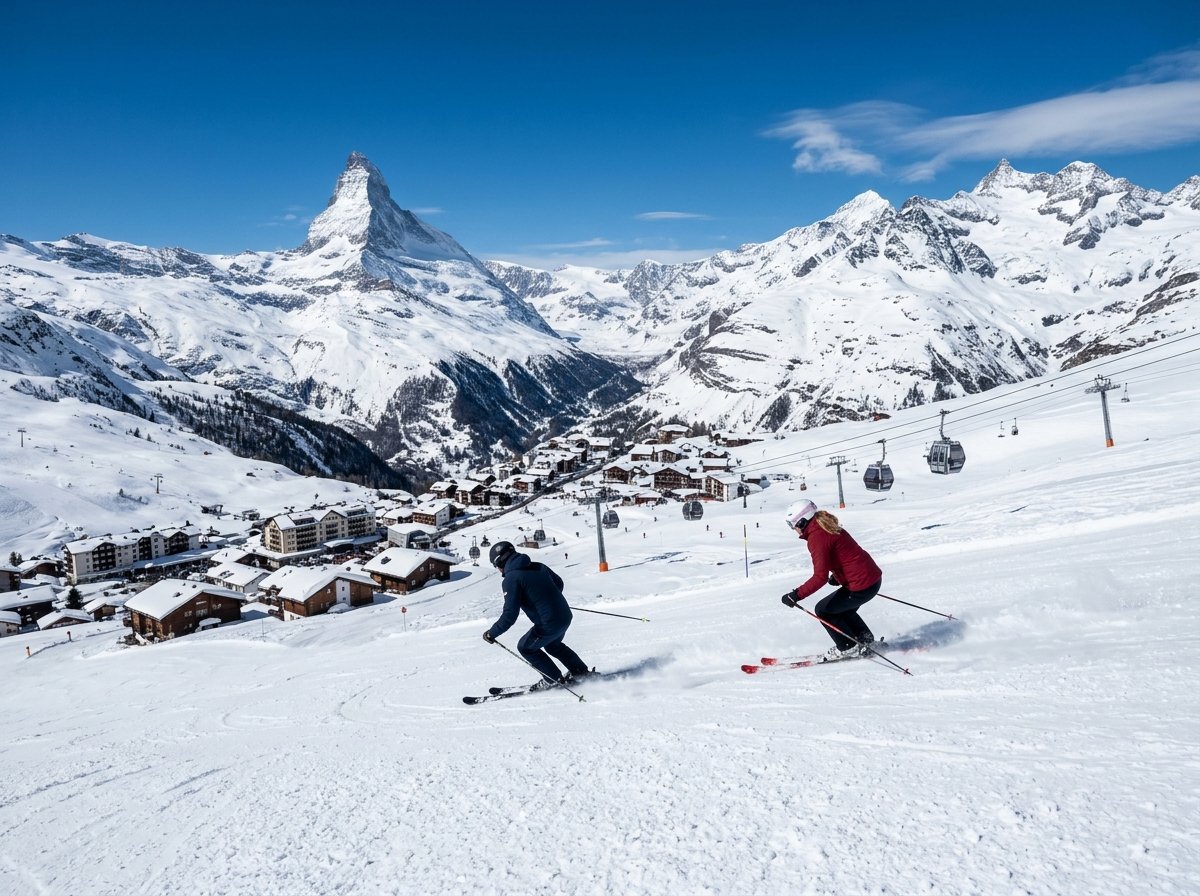
The Unrivaled Icon: Zermatt
Best For: The definitive bucket-list ski experience, mixed-ability groups, and guaranteed 365-day skiing on a glacial scale. Zermatt’s car-free policy, unparalleled lift system, and link to Italy’s Cervinia create a unique, climate-resilient alpine circuit that sets the global standard.
The Expert’s Sanctuary: Verbier (4 Vallées)
Best For: Advanced to expert skiers, off-piste purists, and a vibrant, international social scene. As the core of the 410 km 4 Vallées, Verbier delivers the Alps’ most respected and challenging terrain, backed by a deep culture of mountain guiding and freeride innovation.
The Conscious Value Champion: Anzère
Best For: Budget-conscious skiers, families, and intermediates seeking sunny, uncrowded slopes with modern infrastructure. This south-facing Valais secret offers a car-free village, efficient lifts, and day passes nearly 45% cheaper than marquee names, all while delivering an authentic, relaxed Swiss experience.
Comprehensive Analysis: The 9 Best Swiss Ski Resorts for 2026
Switzerland’s alpine diversity is immense. This detailed, resort-by-resort analysis provides the granular data and nuanced insights required for your 2026 decision, covering real costs, terrain specifics, and strategic advice.
#1: Zermatt – The Alpine Benchmark
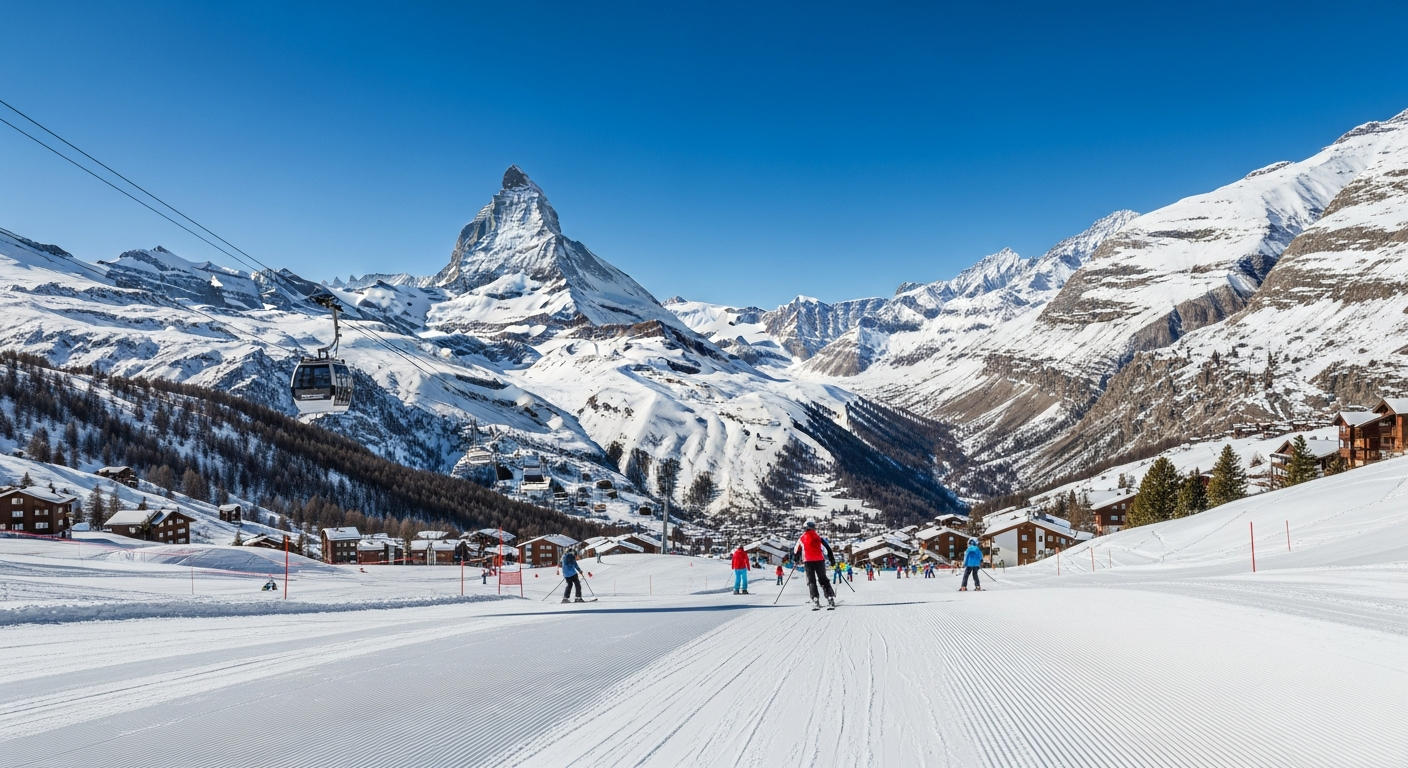
The car-free village of Zermatt (1,620m) is the global synonym for high-alpine skiing. Its scale, polish, and year-round operation on the Theodul Glacier (up to 3,883m) are unmatched in the Alps. The international ski pass, covering Zermatt and Italy’s Cervinia, creates a unique 500+ km circuit with distinct cultural flavors on either side of the border. For 2026, its investment in snowmaking and glacial skiing represents the ultimate climate hedge.
2026 Key Statistics & Real Costs:
- Ski Area: 360 km in Switzerland, plus 160 km in Cervinia, Italy (fully linked).
- Top Station Altitude: 3,883 m (Klein Matterhorn).
- 2025/26 Peak Day Pass: 95 CHF. Early online purchase (7-day advance) reduces cost to 78 CHF.
- Realistic Daily Budget (Mid-Range): 250-300 CHF (includes lift pass, mid-range ski rental, mountain lunch, and casual dinner).
- Optimal Transfer: 3h 15min by direct train from Zurich Airport (ZRH) via Visp.
- Snow Guarantee: Average winter base depth of 150+ cm (Jan-Mar). Theodul Glacier provides 365-day skiing.
Terrain Breakdown & Who It Suits: Zermatt is masterfully zoned. Beginners have dedicated, sunny areas at Sunnegga and Blauherd. Intermediates revel in the long, scenic reds descending from Gornergrat and Hohtälli. Experts test themselves on the harrowing Schwarzsee blacks and the immense off-piste of the Stockhorn and Triftji areas. The Italian side offers sun-drenched, gentle cruising perfect for spring afternoons.
Ideal For: Skiers of all levels seeking the quintessential Alpine postcard, luxury travelers, and mixed-ability groups who value iconic scenery, supreme snow certainty, and a vast, varied domain.
Consider Alternatives If: You are on a strict budget, prefer a single massive interconnected area without international border crossings, or seek a youthful, rowdy aprés-ski scene; Zermatt’s nightlife is sophisticated but subdued.
#2: Verbier (4 Vallées) – The Freeride Capital
Verbier is the spiritual and physical home of expert skiing in Switzerland. Its terrain within the vast 4 Vallées network is steep, deep, and endlessly varied. The culture is unapologetically sport-focused and cosmopolitan, radiating from the bustling Place Centrale.
2026 Key Statistics & Real Costs:
- Ski Area: 410 km across Verbier, Nendaz, Veysonnaz, Thyon, and La Tzoumaz.
- Top Station Altitude: 3,330 m (Mont-Fort).
- 2025/26 Day Pass: 89 CHF (Full 4 Vallées). Verbier-only area pass: 77 CHF.
- Realistic Daily Budget: 230-270 CHF. Legendary aprés-ski at spots like Pub Mont Fort can significantly increase daily spend.
- Optimal Transfer: 2 hours by car or train/bus from Geneva Airport (GVA).
- Off-Piste Dominance: Over 200 marked itineraries and certified freeride zones. A professional guide is highly recommended for most.
Terrain Breakdown & Who It Suits: Verbier’s fame rests on legendary off-piste: the tortuous Tortin, the immense backside of Mont Gelé, and the glacial reaches of Mont Fort. It also boasts superb, challenging red runs like Gentianes. The 4 Vallées link provides endless intermediate cruising across south-facing slopes, making it viable for mixed groups. The Savoleyres sector offers quieter, family-friendly terrain.
Ideal For: Confident intermediate to expert skiers and snowboarders, off-piste enthusiasts requiring guide services, and social skiers who thrive in a vibrant, international scene with legendary mountain dining.
Consider Alternatives If: You are an absolute beginner, a family with toddlers seeking gentle nursery slopes at the village center, or you prefer traditional chalet architecture over Verbier’s more purpose-built, utilitarian aesthetic.
#3: Jungfrau Region (Grindelwald-Wengen) – The Scenic Railway Kingdom
Anchored by Grindelwald and the car-free villages of Wengen and Mürren, the Jungfrau Region offers cinematic drama beneath the north face of the Eiger, Mönch, and Jungfrau. The 2020 inauguration of the Eiger Express gondola slashed travel time from Grindelwald to the glacier by 47 minutes, revolutionizing accessibility.
2026 Key Statistics & Real Costs:
- Ski Area: 210 km of interconnected pistes across Grindelwald, Wengen, and Mürren.
- Top Station Altitude: 3,454 m (Jungfraujoch – Top of Europe railway terminus).
- 2025/26 Day Pass: 79-89 CHF (region-wide). The “Jungfrau Travel Pass” combining rail and ski offers excellent value.
- Realistic Daily Budget: 210-250 CHF.
- Optimal Transfer: 2h 45min by train from Zurich Airport (ZRH) via Interlaken.
- Unique Selling Point: Ski pass includes access to the Jungfraujoch railway, a breathtaking non-ski attraction.
Terrain Breakdown & Who It Suits: The area excels in long, scenic descents like the legendary Lauberhorn World Cup run. Grindelwald-First is a freestyle haven with a renowned park. The wide-open, sunny slopes around Kleine Scheidegg and Männlichen are intermediate paradise. Note: primary ski altitudes are lower than Valais glaciers; for optimal snow cover, target February and March.
Ideal For: Scenery lovers and photographers, intermediate cruisers, families (especially in the tranquil, traffic-free setting of Wengen), and travelers who appreciate historic mountain railways as an integral part of the alpine experience.
Consider Alternatives If: You are an expert seeking consistently steep on-piste terrain, demand the highest altitude glacial guarantees for late-season (April) skiing, or prefer a single concentrated ski base over multiple charming villages accessed by train.
#4: Saas-Fee – The Peaceful Glacier Sanctuary
Dubbed the “Pearl of the Alps,” car-free Saas-Fee (1,800m) provides a tranquil, family-oriented, and authentically Swiss alternative to its famous neighbor Zermatt. Its high-altitude ski area on the Fee Glacier ensures exceptional snow reliability from late October through early May.
2026 Key Statistics & Real Costs:
- Ski Area: 145 km of pistes, with significant expansion planned on the glacier for 2025/26.
- Top Station Altitude: 3,600 m (Mittelallalin, home to the world’s highest revolving restaurant).
- 2025/26 Day Pass: 74 CHF. Family passes offer discounts of up to 30% for two adults and two children.
- Realistic Daily Budget: 190-230 CHF.
- Optimal Transfer: 3h 30min by train/bus from Geneva Airport (GVA) via Visp.
- Snow Guarantee: Glacier snow depth averages 200+ cm year-round, with 85% of the domain above 2,500m.
Terrain Breakdown & Who It Suits: Terrain is predominantly intermediate, featuring long, gentle blues and scenic reds that descend from the glacier to the village edge. The snowpark on the glacier is world-class and open most of the year. Ideal for skill progression and family weeks. Advanced skiers will find marked piste variety limited after 2-3 days but can access excellent guided off-piste and alpine routes.
Ideal For: Families with children of all ages, intermediate skiers seeking confidence-building miles, couples desiring a romantic and peaceful atmosphere, and glacier skiing purists who prioritize snow certainty and a traditional, vehicle-free village feel.
Consider Alternatives If: You are an advanced piste-basher seeking vast kilometer counts of challenging groomers, or a traveler wanting bustling nightlife and a cosmopolitan party scene; aprés-ski here is relaxed and family-friendly.
#5: Davos Klosters – The Vast, Dispersed Network
Davos and Klosters form one of Switzerland’s largest and most diverse ski regions, spread across five distinct mountains. This natural dispersion effectively spreads crowds and offers genuine daily variety, from Olympic-level freestyle hubs to gentle, sunny family areas.
2026 Key Statistics & Real Costs:
- Ski Area: 320 km across Parsenn, Jakobshorn, Rinerhorn, Madrisa, and Pischa.
- Top Station Altitude: 2,844 m (Weissfluhjoch, Parsenn).
- 2025/26 Day Pass: 80 CHF for the full Davos Klosters area.
- Realistic Daily Budget: 220-260 CHF. Davos is a full-service conference town with a wide range of dining, often at city prices.
- Optimal Transfer: 2h 15min by direct train from Zurich Airport (ZRH).
- Crowd Dispersion: Skier density is approximately 15-20% lower than in comparably-sized monolithic resorts due to the five separate mountain access points.
Terrain Breakdown & Who It Suits: Parsenn is legendary for its endless, rolling reds and the epic 12 km descent to Küblis. Jakobshorn is a freestyle and snowboard mecca with vibrant aprés-ski at the Jatzhütte. Madrisa is explicitly designed for families. Klosters offers traditional charm and attracts advanced skiers for its challenging off-piste, notably the Gotschna Freeride Arena.
Ideal For: Skiers planning week-long trips who crave daily variety without repeating slopes, families with diverse interests (skiing, sledding, ice skating), and those who appreciate a real, vibrant town with extensive non-ski amenities like world-class ice hockey, shopping, and cultural events.
Consider Alternatives If: You seek a compact, pedestrian-only chocolate-box village, or require the highest altitude glacier guarantees for late-April skiing; while altitude is respectable, it is not glacial.
#6: Engelberg-Titlis – The Accessible Glacier from Zurich
Engelberg’s prime advantage is unparalleled proximity to Switzerland’s main air hub: just 90 minutes from Zurich Airport, delivering genuine high-alpine glacier skiing. While popular for day trips, it holds immense value for short stays, especially for experts seeking efficient, high-impact skiing.
2026 Key Statistics & Real Costs:
- Ski Area: 82 km of pistes, with a focus on quality over quantity.
- Top Station Altitude: 3,238 m (Titlis Glacier).
- 2025/26 Day Pass: 74 CHF. The SBB Snow’n’Rail combo ticket from Zurich saves up to 20% on travel and lift pass.
- Realistic Daily Budget: 180-220 CHF.
- Optimal Transfer: 1h 30min by direct train from Zurich Airport (ZRH).
- Strategic Insight: ~40% of visitors are day-trippers. For a relaxed experience, plan your skiing for weekdays and explore the village’s historic monastery on a weekend afternoon.
Terrain Breakdown & Who It Suits: The Titlis glacier offers guaranteed snow and a limited but scenic selection of red and blue runs. The main draw for experts is the legendary off-piste, including the Laub, a 2,000m vertical north-facing descent. The separate Gerschnialp and Brunni areas are perfect for beginners and families. The terrain is bifurcated, requiring a bus or cable car to switch between the Titlis and Brunni sectors.
Ideal For: Experts and off-piste enthusiasts based in or transiting through Zurich, day-trippers seeking a high-alpine fix, and travelers combining a 2-3 day city break in Zurich or Lucerne with a short, intense ski stint.
Consider Alternatives If: You are an intermediate skier seeking a vast, interconnected network of groomed runs for a full week, or a family wanting a fully integrated, pedestrian village where all lifts and amenities are within walking distance.
#7: St. Moritz – The Glamorous Alpine Playground
St. Moritz is synonymous with luxury, sport, and cosmopolitan flair. Its diverse terrain across Corviglia, Corvatsch, and Diavolezza offers reliable snow and breathtaking Engadin scenery, complemented by a world-class off-slope scene of fine dining, fashion, and iconic events.
2026 Key Statistics & Real Costs:
- Ski Area: 350 km of pistes across the linked Engadin region.
- Top Station Altitude: 3,303 m (Corvatsch).
- 2025/26 Day Pass: 85 CHF (St. Moritz Corviglia only). The full Engadin Pass covering all areas: 92 CHF.
- Realistic Daily Budget: 300-400+ CHF. This reflects its luxury positioning; mountain lunches at places like El Paradiso or Alpina
Editorial standards
Why trust this guide
- Route-checked. Itineraries, transfers and timings are verified against current public-transport schedules and operator pages.
- Honest comparisons. Hotel areas and tours are compared on real value — affiliate links never change the recommendation.
- Transparent. Some links are affiliate links; the disclosure is shown on every guide.
This guide is informational travel content, not professional travel, financial or legal advice. Always confirm prices, opening times and conditions with the official provider before you book.
Related guides