Data and attraction details in this guide reflect 2026 figures from Switzerland Tourism and the official Zermatt tourism board. Prices are approximate and may vary by season. Glacier Express Train Guide Switzerland 2026: Dream Rail…
This post contains affiliate links. We earn a small commission at no extra cost to you. Switzerland Skiing Guide: 9 Best Resorts for 2026 (Real C…
Zermatt 3-Day Itinerary: How to Spend 72 Hours in 2026
TL;DR
- Total budget: CHF 640–1,400 per person for 3 days mid-range, excluding flights
- Best months: July, September for glacier hiking and highest summer lift runs; December, April for top-tier skiing on the Matterhorn glacier (year-round skiing available)
- Must-do: Sunrise at Gornergrat Bahn (arrive at 3,089m), walk to Riffelsee for the Matterhorn reflection shot, ride Glacier Paradise (Europe’s highest cable car at 3,883m), eat fondue at Chez Vrony
- Skip: Bahnhofstrasse watch shopping unless you want it; the Matterhorn Museum is skippable on a tight schedule; riding e-bikes in the village (banned)
- Getting around: Car-free village. Walk, use the free shuttle bus, or take electric taxis. The Gornergrat Bahn and Matterhorn lifts are the main transport
Zermatt is the Swiss mountain town everybody knows by the mountain above it. The Matterhorn (4,478m) is the most photographed mountain in the Alps, the symbol on every Toblerone bar, and the reason 3 million people visit Zermatt every year. The village sits at 1,620m at the dead end of a valley reachable only by train (no cars allowed in Zermatt since 1961), with 5,800 permanent residents who speak Walser German and keep black-nosed sheep. Grindelwald Switzerland Travel Guide 2026: Costs, Itinera…
For more context, see our Swiss budget travel tips for planning tips that apply across Swiss destinations.
For more context, see our Switzerland travel guide for planning tips that apply across Swiss destinations.
I’ve spent half my life skiing the Matterhorn’s glaciers and the other half trying to explain to friends that Zermatt is genuinely worth the high prices. This is the 3-day itinerary I send them. Not the “see the Matterhorn from Gornergrat once” version, the one where you watch it from three different angles, walk to a hidden lake for the reflection photo, and understand why Switzerland’s most expensive village earns it.
Check flights to Zurich or Geneva on Trip.com — Zurich is 3h15 to Zermatt by direct train; Geneva is 3h50.
How Do You Get to Zermatt?
Zermatt is reachable only by train, with cars stopping at Tasch station 5 km down the valley. The approach is part of the experience.
Zermatt is reachable only by train. Cars stop at Tasch station (5 km down the valley), where a shuttle train runs to Zermatt every 20 minutes (CHF 16 return, 12 min). Paid car parks at Tasch (CHF 16/day) fill up in high season.
From Swiss airports: Zurich Airport to Zermatt takes 3h15 (CHF 88), Geneva Airport to Zermatt is 3h50 (CHF 88), both via the Bern-Visp route. The Glacier Express scenic train runs direct Zermatt to St. Moritz in 8 hours (CHF 169 one-way plus compulsory reservation CHF 49 in high season), one of the world’s most famous rail journeys.
International: Milan to Zermatt is 5h30 via the Simplon tunnel (CHF 110), Paris to Zermatt 6h45 (CHF 180–260).
The Swiss Travel Pass is worth considering. It covers the trains from airports, includes 50% off Gornergrat Bahn (the most expensive rail line in the village), and 25% off the Matterhorn Paradise cable cars.
For broader Swiss rail context, see our scenic trains guide.
Where Should You Stay in Zermatt?
Zermatt is expensive across all categories, but the three main stay zones offer meaningful differences in price and character.
Zermatt is expensive. Budget hotels don’t really exist at a Western standard, the “cheapest” 3-stars run CHF 220–380/night in peak season. The village has 120+ hotels and 300+ apartments, so availability isn’t the problem, cost is.
Bahnhofstrasse / Kirchplatz (center) — The main pedestrian street and the church square at its end. Walk to everything. CHF 250–450/night for 3- and 4-stars. Hotel Monte Rosa (where the Matterhorn was first climbed in 1865), Hotel Bristol, Hotel Alex.
Winkelmatten / Oberdorf — Quieter village areas on the south side of the river, 5–10 min walk to center. Hotels from CHF 200–340. Family-owned pensions and chalets. Better Matterhorn view from some rooms.
Mountain hotels — Riffelalp, Schwarzsee, and the Gornergrat hotel all offer nights on the mountain (CHF 280–750). Ski-in/ski-out, sunrise with the Matterhorn from your window.
| Neighborhood | Price Range/Night | Best For | To Gornergrat Bahn |
|---|---|---|---|
| Bahnhofstrasse center | CHF 250–450 | First-timers, shopping | 0–5 min walk |
| Winkelmatten/Oberdorf | CHF 200–340 | Quiet, value | 10 min walk |
| Mountain hotels | CHF 280–750 | Splurge, sunrise | On the mountain |
| Hostels (Youth Hostel Zermatt) | CHF 85–120 dorm | Backpackers | 5 min walk |
[Source: Zermatt Tourism]
Compare Zermatt hotel prices on Booking.com — free cancellation gives flexibility around weather, which matters when your plans depend on clear-sky Matterhorn views.
Day 1: Gornergrat and First Matterhorn Views
Morning (7:00 to 12:00)
The first day centers on the Gornergrat Bahn, the 1898 cogwheel railway that delivers the best first view of the Matterhorn’s east face at sunrise, and the Riffelsee reflection shot that most visitors come specifically to photograph.
Board the Gornergrat Bahn at 7:00 or 7:24am for sunrise. The 1898 cogwheel railway climbs from Zermatt (1,620m) to Gornergrat (3,089m) in 33 minutes, passing the Matterhorn on the left. Sunrise hits the Matterhorn’s east face around 7:30–8am in summer, turning the rock a pink-orange that photographs perfectly. Fare: CHF 132 return, 50% with Swiss Travel Pass (CHF 66). [Source: Gornergrat Bahn]
At Gornergrat: two viewpoints, a hotel, a restaurant, an observatory, and direct views of 29 peaks above 4,000m, the Matterhorn in front, the Monte Rosa group (4,634m) behind you, the Gorner Glacier spread below. Allow 90 minutes at the top. (source: U.S. travel advisories)
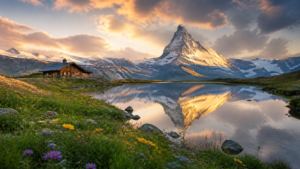
From Gornergrat, walk the Riffelsee trail (20 min down to the Rotenboden station). Riffelsee is the small Alpine lake where the Matterhorn reflects, the photo that most Zermatt postcards use. Calm morning light is best for the reflection; by 10am ripples appear. Return to Zermatt by train from Rotenboden (CHF 42) or walk the 1.5-hour trail back via Riffelberg. (source: EU tourism statistics)
Afternoon (12:00 to 17:00)
Lunch: Chez Vrony (Findeln, 40 min walk from Sunnegga or Riffelalp), the most famous mountain restaurant in Zermatt. A farmhouse at 2,100m with a terrace directly facing the Matterhorn. The Vrony family’s fondue with wild herbs, homemade ravioli CHF 32, and a CHF 12 local draft beer. Reserve 5–7 days ahead. [Source: Chez Vrony]
Alternative lunch spots: Findlerhof (across the Findeln hamlet, CHF 28–45) or Adler Hitta (Blauherd-Unterrothorn, CHF 26–42).
After lunch, take the Sunnegga funicular (CHF 32 return) from the village to Sunnegga (2,288m). At Sunnegga, several walking options:
- Blauherd and Rothorn via cable car (CHF 60 total return), 3,103m with full Matterhorn panorama
- Leisee lake, a small mountain lake popular for summer swimming at 2,232m, water hits 18°C in August
- Riffelsee loop, longer walk back down to Findeln and lunch area
In the afternoon, the Matterhorn’s west face catches sun 3–6pm, so west-facing viewpoints (Findeln, Sunnegga) look best.
| Attraction | 2026 Price | Time Needed | Book Ahead? |
|---|---|---|---|
| Gornergrat Bahn | CHF 66 (STP) / CHF 132 full | Half day | Peak summer yes |
| Matterhorn Glacier Paradise | CHF 95 (STP) / CHF 126 full | Half day | No |
| Sunnegga-Rothorn round trip | CHF 60 return | 3h | No |
| Chez Vrony lunch | CHF 48–72 with wine | 2h | Yes, 5+ days |
| Matterhorn Museum (Zermatlantis) | CHF 12 | 1.5h | No |
| Ski day pass (Zermatt-Cervinia) | CHF 105 full | All day | No |
[Source: Zermatt Tourism, Matterhorn Paradise]
Evening (19:00 to 22:30)
Dinner: Chez Heini (Bahnhofstrasse 80), the classic Zermatt lamb restaurant, the rack of lamb (Heinis Signature) CHF 68, ambiance and service that’s been consistent since 1974.
Budget: Stockhorn Grill (Riedstrasse 11), CHF 28–42 grilled meats and fondue, woodsy atmosphere without Bahnhofstrasse prices.
Walk Bahnhofstrasse back to your hotel. The Matterhorn silhouettes against the night sky at the top of the street. You can photograph it from Kirchbrucke (the church bridge) without any streetlights in the frame.
Day 2: Matterhorn Glacier Paradise, the Highest Cable Car in Europe
Morning (8:00 to 13:00)
Day 2 takes you to 3,883 meters, the highest point accessible without climbing in Switzerland, and gives you the option of crossing into Italy for the afternoon.
Walk to the Matterhorn Glacier Paradise cable car station (15 min from village center) and board the first cable car. The 30-minute ride carries you to Klein Matterhorn at 3,883m, the highest cable car station in Europe and the highest point accessible without climbing in Switzerland. Fare: CHF 126 return, 25% with Swiss Travel Pass.
At the top:
– Glacier Palace, ice-carved chambers inside the glacier, 15m below the surface
– Cinema Lounge, looped Matterhorn documentary
– Viewing platform, 360-degree view of 38 peaks above 4,000m on clear days
– Restaurant, the highest-altitude restaurant in Switzerland, CHF 32–58 lunch
– Year-round skiing and snowboarding on the glacier
The 2023 Matterhorn Alpine Crossing opened a lift connection from Klein Matterhorn down to Cervinia, Italy at 2,004m (Testa Grigia to Cervinia). This makes a cross-border mountain round trip possible: ski or ride down the Italian side, take the Cervinia-to-Chatillon bus, train back through the Simplon Pass to Zermatt. 8-hour excursion CHF 249 including all transport and the Cervinia pass. Book ahead; weather-dependent. [Source: Matterhorn Paradise]
Afternoon (13:00 to 17:30)
Descend via cable car to Schwarzsee (2,583m), a small Alpine lake with the Chapel Maria zum Schnee on its shore. The chapel has been a climbers’ pilgrimage site since 1949. Walk the lake loop (30 min), eat at Restaurant Schwarzsee (CHF 28–42), or continue to Hornlihutte, the 3,260m mountain hut that serves as the base for Matterhorn summit attempts. The hut is accessible via a 2-hour panoramic hike from Schwarzsee (moderate difficulty, experienced hikers only after snow melt).
Alternative afternoon: walk the Gornerschlucht (Gorner Gorge) trail, a wooden walkway through a dramatic gorge 15 min from the village, CHF 7 entry, 45 min walk. The gorge is a rare accessible view of the Gorner Glacier’s melt water.
For broader mountain context, see our mountains and hiking guide.
Evening (19:00 to 22:30)
Dinner: Restaurant Schaferstube at Hotel Julen (Riedstrasse 2), the best Swiss lamb (the Julen family raises black-nosed sheep themselves), rack of lamb CHF 58, mains CHF 38–68, rustic wood-panelled dining room that looks the way Zermatt restaurants look in ski-brochure photos.
Or cheaper: Walliserkanne (Bahnhofstrasse 32), traditional Valais restaurant, fondue CHF 34, raclette CHF 36, local Dole and Fendant wines.
Day 3: Hiking the 5-Lakes Trail and the Deep-Cut Zermatt
Morning (7:30 to 12:30)
The 5-Lakes Walk is the signature summer hike: 10 km of downhill trail connecting five mountain lakes with multiple Matterhorn reflection spots, best done early before the afternoon light flattens the views.
5-Lakes Walk (5-Seenweg), the signature summer hike from Blauherd (2,571m, reached by Sunnegga funicular + cable car) descending to Leisee (2,232m), then through Moos See, Grindjisee, Grunsee, and Stellisee back to Sunnegga. 3 hours moderate downhill, 10 km, several Matterhorn view points including Stellisee which has the second-most-photographed reflection of the mountain after Riffelsee. Best done 7:30am–11am for calm reflective lakes and soft light.
Alternative: if you prefer less walking, Riffelberg to Gornergrat via Rotenboden is a 45-min flat trail with Matterhorn views on one side and glacier view on the other.
Afternoon (12:30 to 17:00)
Lunch at Fluealp (2,606m, 20 min walk from Blauherd), traditional Alpine hut, mountain specialties CHF 22–38, the Kaiserschmarren (shredded pancake) is a post-hike reward.
Back in the village by 14:00. Afternoon options:
- Matterhorn Museum (Zermatlantis) (Kirchplatz), CHF 12, 1.5h. The 1865 first ascent story, the broken rope that killed 4 climbers on the descent, the Edward Whymper sketches.
- Gornerschlucht (Gorner Gorge) if you skipped Day 2
- Walk the Old Village (Hinterdorf), the cluster of 16th-century wooden houses on raised stone supports (to keep mice out of grain stores), preserved at the south end of the village. Atmospheric 20-minute walk, free.
- Bahnhofstrasse window shopping, the highest-altitude Rolex store in the world is at Bahnhofstrasse 22.
- Hike to Trift Hotel (moderate, 2h up from Zermatt), a 1886 family-run chalet hotel at 2,337m. Best cheap accommodation in Zermatt if you want an overnight.
For activities you want pre-booked, including guided glacier walks, via ferrata, and mountain photography tours, GetYourGuide lists Zermatt-specific options with English-speaking guides.
For cost planning, see our budget Switzerland guide.
Evening (19:00 to 22:00)
Last dinner: Whymper-Stube at Hotel Monte Rosa (Bahnhofstrasse 80), named for the first Matterhorn ascender, this is where climbers’ dinners happen in mountaineering season. Fondue CHF 36, lamb shanks CHF 45, rustic wooden room. Reserve.
Walk Bahnhofstrasse at night, photograph the Matterhorn from Kirchbrucke one final time.
Zermatt 3-Day Budget Breakdown
Here’s what three days in Zermatt actually costs per person in 2026, mid-range choices:
| Category | Budget | Mid-Range | Splurge |
|---|---|---|---|
| Accommodation (3 nights) | CHF 255–360 (hostel/cheap apartments) | CHF 660–1,050 (3-star) | CHF 1,200–2,250 (4/5-star Matterhorn-view) |
| Food and drink (3 days) | CHF 150–220 | CHF 290–420 | CHF 540–800 |
| Mountain excursions | CHF 200–280 (one excursion) | CHF 480–680 (Gornergrat + Glacier Paradise) | CHF 800–1,100 (add cross-border, 5-lakes) |
| Local transit (shuttle to Tasch) | CHF 32 | CHF 32 | CHF 32 |
| Total per person | CHF 640–890 | CHF 1,460–2,180 | CHF 2,570–4,180 |
Budget uses the Youth Hostel, self-cater from Coop (the small Coop near the station has limited but fair-priced groceries), one mountain excursion. Mid-range includes 3-star hotel, Gornergrat, Matterhorn Paradise, two Chez Vrony-class lunches, one Whymper-Stube dinner. Splurge adds a 4-star Matterhorn-view room, Mountain Crossing to Cervinia, skiing or 5-lakes walk with guide.
The Swiss Travel Pass saves CHF 100–180 across 3 days in Zermatt with the Gornergrat 50% discount alone. The Peak Pass (all-lift ticket) is CHF 187 for 3 days, worth it only if you ride 3+ lifts per day.
Getting Around Zermatt Without a Car
You literally can’t drive in Zermatt. Electric taxis (CHF 15–30 per ride), horse carriages (CHF 25–50, mostly for show), and your feet are the options.
- Bahnhofstrasse runs north-south through the village, 10 min end to end
- Free shuttle bus runs every 10 min between key locations (Bahnhofstrasse, Matterhorn Paradise station, Winkelmatten)
- Mountain railways connect to every viewpoint
Check MyMatterhorn app for lift operating status, weather, and ticket purchases. For luggage from Tasch to Zermatt hotels, most hotels arrange pickup at the Zermatt station on request (CHF 10–20 per bag tip).
When Is the Best Time to Visit Zermatt in 2026?
Zermatt has two genuinely distinct seasons, each with a strong case: summer for hiking and the most Matterhorn visibility, winter for skiing at the highest-altitude ski area in the Alps.
Late June, early September: Summer peak. All lifts open, glacier hiking, maximum trail coverage, warmest weather (10–18°C daytime at 2,000m). Hotel prices 30–50% above winter. Book 2–3 months ahead.
September, mid October: Shoulder. Crowds thin after Swiss schools return, weather often clearest of the year (dry cool air reveals peaks clearly), early snow dusting on Matterhorn. Some summer lifts close end-September.
December, April: Ski season. The Matterhorn Glacier Paradise offers year-round skiing, and the main season runs December through mid-May. 360 km of pistes combined with Cervinia (Italy). The Cervino Ski Paradise cross-border pass is CHF 110/day. Peak prices mid-December to early January and mid-February to early March.
May: Shoulder spring. Lower lifts reopening, snow melt, not the best time unless you specifically want spring skiing. [Source: Zermatt Ski Info]
Plan your Zermatt trip on Trip.com — flights, hotels, and mountain rail tickets with most cancellable.
FAQ: Zermatt 3-Day Itinerary
Is 3 days enough for Zermatt?
Three days covers the essentials: Gornergrat + Matterhorn Paradise + one hike (5-lakes) or a Cervinia crossing. If the weather is variable, add a buffer day (4–5 total) because the Matterhorn disappears into cloud about 40% of summer afternoons. Winter skiers typically spend 5–7 days. Many Europeans just come for a weekend, but 3 days is the sweet spot for a trip you planned around.
How much does a trip to Zermatt cost in 2026?
A mid-range 3-day trip costs roughly CHF 1,460–2,180 per person, the most expensive city-style trip in Switzerland. 3-star hotels run CHF 220–380/night, mountain lifts eat CHF 150–300/day, meals CHF 80–150/day. Budget travelers in hostels doing selective lifts can do it for CHF 640–890. The expense is real; the view is also real.
Can you swim anywhere near Zermatt?
The village pool (CHF 9, at the Hotel Julen complex) and Leisee mountain lake (free, 18°C in August) are the main swimming options. Leisee is reached via the Sunnegga funicular, small, popular with families, genuinely unusual because you swim with the Matterhorn in view. Note: it’s cold (12–18°C peak), bring your own towel.
What food is Zermatt known for?
Valais specialties: Valais raclette (considered the original raclette cheese, melted on an open fire over bread and boiled potatoes), Trockenfleisch (air-dried beef), Valais rye bread (a tradition since the 14th century, UNESCO intangible heritage), and Fondue with Fendant wine. Black-nosed sheep from Valais produce the distinctive Walliser Lamm, order rack of lamb at Chez Heini or Julen’s Schaferstube.
Is Zermatt the most expensive town in Switzerland?
Yes. Zermatt consistently ranks as the most expensive Swiss resort and among the 5 most expensive mountain resorts globally. Hotel prices average 40–60% above St. Moritz and 60–80% above Grindelwald. A casual lunch CHF 35–55, a fondue dinner CHF 40–65 per person. The best savings come from self-catering apartments (CHF 130–260/night for 2-bed), pizzas at local chains, and the Swiss Travel Pass.
What’s the best way to get from Zurich Airport to Zermatt?
The SBB Intercity runs direct from Zurich Airport to Visp (1h55), then change to the Matterhorn Gotthard Bahn to Zermatt (1h20). Total 3h15, fare CHF 88, included in the Swiss Travel Pass. Reserve seats on the Visp-Zermatt segment in summer peak (compulsory for Glacier Express, optional for regional). Alternative: drive from Zurich to Tasch 3h + 12 min shuttle train, only if you need a car for another part of the trip.
What is the Riffelsee and why do people hike to it?
Riffelsee is a small Alpine lake at 2,757m, reached by walking 20 minutes down from the Rotenboden station on the Gornergrat Bahn. On still mornings, the lake surface reflects the Matterhorn with perfect clarity, the image used on most Zermatt postcards and in many photography guides. Go before 10am; wind picks up later and breaks the reflection. Admission is free; the Rotenboden station costs CHF 42 as a stop on the Gornergrat line.
Is Zermatt worth visiting in winter?
Absolutely, winter is Zermatt’s primary season. 360 km of pistes (including Cervinia), top-tier ski schools, and the highest-altitude skiing in the Alps (3,899m). The Matterhorn has 3 lit panoramic restaurants open for ski lunches. Cross-border skiing to Italy includes a pasta lunch at a fraction of Swiss prices. Hotel prices highest mid-December to early January and February peak to early March; shoulder weeks (early December, mid-January, late March to early April) have value.
Anna Berger writes about Switzerland from the inside for switzerlandvibe.com, the real version, not the toblerone-box one. More Zermatt, Alps, and Swiss rail content throughout 2026.
Editorial standards
Why trust this guide
- Route-checked. Itineraries, transfers and timings are verified against current public-transport schedules and operator pages.
- Honest comparisons. Hotel areas and tours are compared on real value — affiliate links never change the recommendation.
- Transparent. Some links are affiliate links; the disclosure is shown on every guide.
This guide is informational travel content, not professional travel, financial or legal advice. Always confirm prices, opening times and conditions with the official provider before you book.