Affiliate disclosure: This guide contains affiliate links. If you book flights, hotels, or rental cars through these links, we may earn a small commission at no extra cost to you.
Choosing between Switzerland and Austria for a 2026 Alpine trip comes down to dramatic high-altitude glaciers versus lower daily costs and imperial cities. Switzerland wins for iconic 4,000-meter peaks, glacier trains, and clockwork transport. Austria wins for grand palaces and musical history. Daily travel prices also run 35 to 45 percent lower.
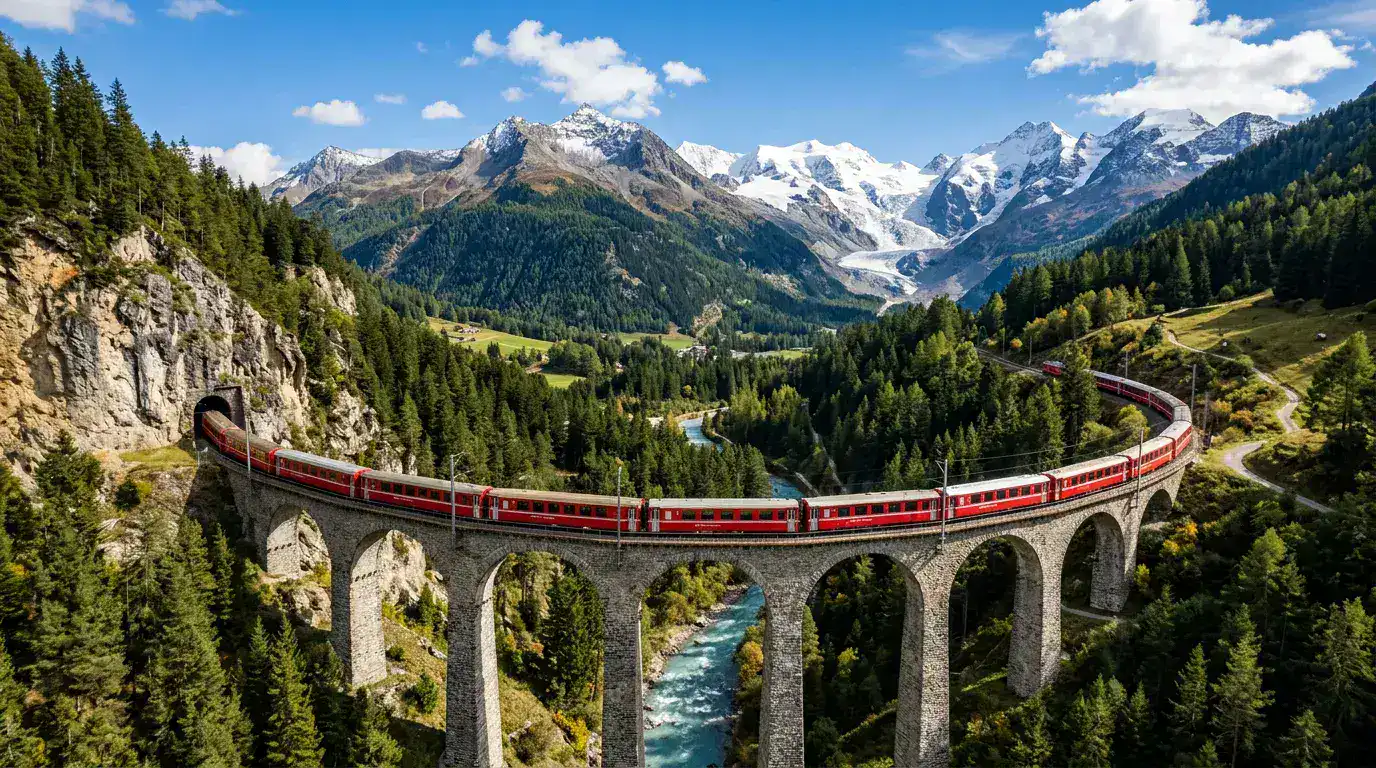
What Makes Swiss Scenic Trains Stand Out?
Switzerland operates dedicated wide rail lines built across high mountain passes and deep gorges. Trains like the Glacier Express and Bernina Express use large curved windows that reach toward the roof. Rack-and-pinion gears allow Swiss mountain trains to climb gradients up to 25 percent, reaching high Alpine stations where cars cannot drive. For full timetable and seat booking details, read our Glacier Express Train Guide 2026.
Onboard service on flagship Swiss scenic routes includes freshly prepared three-course lunches and regional Valais wines served at your seat. If you hold a Swiss Travel Pass, the base rail fare on wide lines is covered. Plus, you only pay the seat booking fee. You can compare all pass options in our Swiss Train Travel Guide 2026.
Swiss Federal Railways (SBB) runs a tight national schedule. Trains, post buses, and lake boats meet at the same minute every hour. That tight schedule makes multi-stop mountain connections reliable even in winter snow.
How Does the Austrian Rail Network Compare?
Austria’s national railway, OBB, focuses on fast intercity Railjet trains linking Vienna, Salzburg, Innsbruck, and Graz. Austria’s most famous historic mountain line is the Semmering Railway, a mid-19th-century UNESCO World Heritage route with stone viaducts and tunnels between Vienna and Graz. Scenic lines like the Arlberg Railway between Innsbruck and Vorarlberg use standard intercity carriages rather than glass-domed tourist cars.
Because Austrian scenic routes serve everyday commuters, tickets cost far less and rarely require extra seat booking fees. OBB Sparschiene advance tickets between Vienna and Innsbruck often start under EUR 30. Austria also leads Europe with its OBB Nightjet sleeper network, offering direct overnight trains to Zurich, Venice, Rome, Amsterdam, and Paris.
If your wider European route includes Prague, Budapest, or Ljubljana, starting in Vienna or Salzburg gives you shorter and cheaper direct rail links than starting in Zurich.
Which Country Offers Better Value for Money in 2026?
Austria is significantly cheaper than Switzerland across hotels, restaurant meals, rail passes, and ski lift tickets. The table below compares typical mid-range travel costs for a 7-day trip in 2026.
| Expense Item. | Switzerland (CHF). | Austria (EUR). | Price Difference. |
|---|---|---|---|
| 8-Day Rail Pass (2nd Class). | CHF 419. | EUR 210 to 250. | Austria is ~40% cheaper. |
| 3-Star Hotel (Per Night). | CHF 200 to 260. | EUR 110 to 150. | Austria is ~45% cheaper. |
| Mid-Range Restaurant Meal. | CHF 35 to 50. | EUR 18 to 28. | Austria is ~45% cheaper. |
| 1-Day Ski Pass. | CHF 75 to 95. | EUR 65 to 78. | Austria is ~15% cheaper. |
| High Mountain Cable Car. | CHF 80 to 210. | EUR 40 to 55. | Austria is ~50% cheaper. |
You can compare live nightly rates in Zurich, Lucerne, Salzburg, and Innsbruck on Trip.com Hotels to see how much further your hotel budget stretches in each region.
How Do Mountains, Hiking, and Skiing Compare?
Switzerland has 48 mountain peaks above 4,000 meters. Meanwhile, Austria’s highest peak, the Grossglockner, stands at 3,798 meters. That altitude difference shows up in the scenery. Swiss hubs like Zermatt (with the Matterhorn) and Lauterbrunnen (with the Eiger, Monch, and Jungfrau) put huge glaciers and vertical rock walls right above the village streets.
Austria’s Alps in Tyrol and Salzburgerland feature wide green valleys, limestone peaks, and traditional timber farmhouses. For winter skiing, Austrian resorts like St. Anton, Ischgl, and Kitzbuhel offer huge linked lift systems, heated chairlifts, and lively apres-ski taverns at lower prices. Switzerland excels at high-altitude spring snow guarantees in Zermatt and Saas-Fee. You also get car-free mountain villages like Wengen and Murren. First-time visitors planning a Swiss mountain loop can check our 2026 Switzerland First-Timer Guide.
Should You Travel by Train or Rent a Car in the Alps?
Before choosing your transport, compare airfares into Zurich, Geneva, Vienna, or Munich using Aviasales. Both Zurich Airport and Vienna Airport have direct main-line train stations inside the terminal.
In Switzerland, trains and post buses reach almost every Alpine village, and famous resorts like Zermatt, Wengen, and Murren ban private cars completely. In Austria, trains connect major cities and the Inn Valley well, but renting a car helps if you want to explore smaller Tyrolean side valleys, Salzkammergut lakes, or the Grossglockner High Alpine Road. You can compare rental car rates in both countries on GetRentacar. Remember that both countries require a highway toll sticker (CHF 40 yearly e-vignette in Switzerland. 1-day or 10-day digital vignette in Austria).
How Do you Choose Between Switzerland and Austria?
- Choose Switzerland if: You want 4,000-meter glaciers like the Matterhorn and Jungfrau. You can ride glass-roofed trains and stay in car-free Alpine villages.
- Choose Austria if: You want a mix of Tyrolean mountain scenery and grand imperial cities like Vienna and Salzburg, enjoy palace museums and classical concerts, or want a lower daily budget.
Frequently Asked Questions.
Is Switzerland or Austria better for a first trip to the Alps?
Switzerland is better if your main goal is dramatic glacier scenery, iconic peaks like the Matterhorn, and effortless train travel. Austria is better if you want to combine mountain valleys with historic cities like Vienna and Salzburg at nearly half the daily cost.
Can you visit both Switzerland and Austria on one train trip?
Yes, direct OBB Railjet trains run several times a day from Zurich Main Station to Innsbruck (3 hours 30 minutes), Salzburg (5 hours 30 minutes), and Vienna (7 hours 50 minutes) via the scenic Arlberg pass.
Which country is better for non-hikers?
Switzerland is easier for non-hikers because cogwheel trains and cable cars carry passengers straight to high viewpoints like Gornergrat, Jungfraujoch, Pilatus, and Rigi with minimal walking required.
Is English widely spoken in both Switzerland and Austria?
Yes, English is spoken at train stations, hotels, and dining spots. Staff at cable car stations speak English too.
Which currency do Switzerland and Austria use?
Switzerland uses the Swiss Franc (CHF). Meanwhile, Austria uses the Euro (EUR). Contactless credit and debit cards are accepted almost everywhere in both countries, though carrying CHF 50 or EUR 50 in cash is useful for rural mountain huts.
Editorial standards
Why trust this guide
- Route-checked. Itineraries, transfers and timings are verified against current public-transport schedules and operator pages.
- Honest comparisons. Hotel areas and tours are compared on real value — affiliate links never change the recommendation.
- Transparent. Some links are affiliate links; the disclosure is shown on every guide.
This guide is informational travel content, not professional travel, financial or legal advice. Always confirm prices, opening times and conditions with the official provider before you book.