Affiliate disclosure: This article contains affiliate links. If you book through our links, SwitzerlandVibe may earn a commission at no extra cost to you.
A two-day Geneva weekend itinerary divides the city across the Rhône River and Lake Geneva. On Day 1, explore the Rive Gauche Old Town, Saint-Pierre Cathedral, the 140-meter Jet d’Eau, Bains des Pâquis, and Carouge. On Day 2, visit the Quartier des Nations, the Red Cross Museum, and Plainpalais museums using the free hotel Geneva Transport Card.
2-Day Geneva Itinerary at a Glance
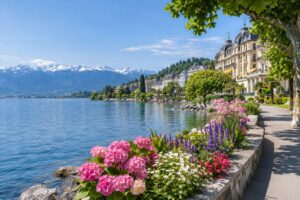
Geneva sits at the southwest tip of Lake Geneva (Lac Léman), where the Rhône River leaves the lake. The river splits the city into two clear halves. The Rive Gauche (Left Bank) holds the hilltop Old Town, the main shopping streets, and the lakeside parks. The Rive Droite (Right Bank) holds Gare de Cornavin train station, the Les Pâquis waterfront, and the United Nations quarter.
Grouping your stops by river bank saves at least an hour of transit each day. According to Geneva Tourism, hotels, hostels, and campsites in the canton give guests a free digital Geneva Transport Card. This pass covers city trams, buses (TPG), yellow lake taxi boats (Mouettes Genevoises), and local trains within zone 10 (Unireso).
| Time Slot | Day 1: Historic Center and Lake | Day 2: Diplomatic Quarter and Arts |
|---|---|---|
| Morning | Old Town, Saint-Pierre Cathedral (157 steps), Place du Bourg-de-Four, Maison Tavel. | Tram 15 to Nations, Broken Chair, Palais des Nations, Red Cross Museum. |
| Afternoon | Jet d’Eau (140 m), Jardin Anglais Flower Clock, swim or lunch at Bains des Pâquis (CHF 2). | Patek Philippe Museum or MAMCO in Plainpalais, Rue du Rhône shops, Quai du Mont-Blanc walk. |
| Evening | Tram 12 or 18 to Carouge for Swiss fondue and local Lavaux or Valais wine bars. | Lakeside dinner in Les Pâquis or evening train onward to Lausanne and Montreux. |
If you plan a longer stay in Western Switzerland, pair this weekend route with our complete Geneva travel guide for 2026.
Day 1 Morning: Old Town and Saint-Pierre Cathedral
Start your first morning in the Vieille-Ville (Old Town) before 9:30 AM. The cobble lanes and stone stairs stay quiet early in the day. Walk south from Gare de Cornavin across Pont du Mont-Blanc, then climb the hill toward the cathedral towers.
Saint-Pierre Cathedral and the Archaeological Site
Cathédrale Saint-Pierre stands at the top of the Old Town hill. Builders started the Romanesque and Gothic church in the 12th century and added the stone front columns in 1756. John Calvin preached inside this nave from 1536 until 1564, and his wooden chair still sits on display.
Entering the main church nave is free. Pay CHF 7 to climb the 157 tower steps. From the top, you get a wide view over red rooftops, Lake Geneva, and the Alps. Plan 45 minutes for the church and the tower climb.
Below the church floor lies the Archaeological Site of Saint-Pierre Cathedral. The underground walk shows 4th-century Roman mosaic floors, old stone walls, and an early Christian baptistery. Adult tickets cost CHF 8, and the route takes about 40 minutes.
Place du Bourg-de-Four and Maison Tavel
Walk three minutes east from the cathedral to reach Place du Bourg-de-Four. This square sits on old Roman market grounds and is the oldest public square in Geneva. Order a morning coffee and croissant at an outdoor table surrounded by 18th-century stone houses.
Two minutes north on Rue du Puits-Saint-Pierre stands Maison Tavel. Builders rebuilt it after a city fire in 1334. Today it is the oldest private house in Geneva and serves as a free city history museum. Go to the top floor to see the Magnin Relief. This large 1:250 scale model shows Geneva in 1850 before the old city walls came down.
Walk downhill toward the lake and buy a pastry near Rue de la Croix-d’Or. Choose a shop one block off the main shopping strip. Side streets in Geneva routinely offer fresher baked goods and lower prices than the main avenues.
Day 1 Afternoon: Jet d’Eau, Jardin Anglais, and Bains des Pâquis
Spend your first afternoon along the shore of Lake Geneva. Walk down from the Old Town to Quai Gustave-Ador on the Rive Gauche to reach the city’s best-known landmark.
The 140-Meter Jet d’Eau
The Jet d’Eau shoots 500 liters of lake water per second to a height of 140 meters at 200 km/h. City engineers first built a smaller water release valve in 1886 for the water power network. They moved the fountain to the lake pier in 1891. Today you can walk out onto the stone jetty right below the plume.
Bring a light rain jacket if you walk to the end of the pier, as wind shifts the spray fast. Viewing the fountains is free. It runs daily year-round, though operators shut it off during high winds or freezing temperatures.
Jardin Anglais and the Flower Clock
Walk west along the water to the Jardin Anglais (English Garden). Near the park entrance sits the Horloge Fleurie (Flower Clock), built in 1955 as a tribute to Geneva’s watchmakers. Gardeners replant the clock face each season with over 6,500 live flowers and shrubs. The park is free and leads straight to Pont du Mont-Blanc.
Bains des Pâquis on the Right Bank
Cross Pont du Mont-Blanc to reach the Rive Droite. You can also take a two-minute Mouettes Genevoises yellow water taxi for free with your transport card. Walk north along the water to Bains des Pâquis, a public bath pier built in 1872. Entry costs CHF 2 for adults during the warm season and is free in winter.
In late summer and early autumn, lake water stays around 18 to 22°C for swimming. The pier café (La Buvette des Bains) serves a daily lunch plate (plat du jour) at low local prices. It also serves cheese fondue in the colder months. Locals of all ages eat and swim here every day. The pier gives you a direct view of the Jet d’Eau across the water.
Day 1 Evening: Dinner and Swiss Wine in Carouge
Skip the hotel restaurants near the train station on Day 1. Ride tram 12 or tram 18 south for 15 minutes to Carouge (stop Carouge-Marché). King Victor Amadeus III of Sardinia planned and built this town in 1786 as a rival border trading post next to Geneva.
Because Turin architects designed the district, Carouge has low two-story houses, painted shutters, and hidden garden courtyards. The streets around Place du Marché and Rue Ancienne pack in traditional bistros and craft workshops. Order a pot of fondue moitié-moitié (half Gruyère AOP, half Vacherin Fribourgeois AOP), which usually costs CHF 26 to CHF 30 per person.
After dinner, stroll along Rue Saint-Joseph and Rue Jacques-Dalphin to try a local wine bar. Ask for a glass of dry Chasselas white wine from the Lavaux terraces or a Pinot Noir from Valais. Switzerland exports less than 2% of its wine harvest, so tasting these bottles in Carouge is a highlight of a weekend trip.
Day 2 Morning: Quartier des Nations and the Red Cross Museum
Dedicate your second morning to International Geneva on the northern edge of the Rive Droite. Board TPG tram 15 at Gare de Cornavin toward Nations; the ride takes 10 minutes.
Palais des Nations and the Broken Chair
Step off the tram at Place des Nations directly in front of the Broken Chair. Swiss artist Daniel Berset created this 12-meter wooden chair with a shattered fourth leg in 1997 for Handicap International to protest landmines. Across the square stands the gate to the Palais des Nations, the European headquarters of the United Nations.
The Palais des Nations hosts more than 10,000 diplomatic meetings every year. You can visit the assembly halls and the Human Rights and Alliance of Civilizations Room on an official guided tour. Check tour schedules and book your slot ahead of time on the United Nations Office at Geneva portal. Walk-in slots often sell out. Bring your physical passport or national ID card for the security gate.
International Red Cross and Red Crescent Museum
Walk five minutes up Avenue de la Paix to the International Red Cross and Red Crescent Museum. Geneva resident Henry Dunant helped found the Red Cross movement here in 1863. The permanent display is called The Humanitarian Adventure. It splits into three halls covering human dignity, family archives, and disaster relief.
Adult tickets cost CHF 15 (CHF 7 for students and reduced fares), and the museum is closed on Mondays. Give yourself at least 90 minutes for the interactive exhibits. The museum restaurant serves fresh midday meals on a quiet terrace before you head back toward the center.
Day 2 Afternoon: Plainpalais Museums, Rue du Rhône, and Quai du Mont-Blanc
From the Nations tram stop, ride tram 15 straight to Plainpalais in about 18 minutes. This district holds two of Geneva’s top specialized museums within one block of each other on Rue des Vieux-Grenadiers.
Option A: Patek Philippe Museum
The Patek Philippe Museum spans four floors inside a restored Art Deco building at Rue des Vieux-Grenadiers 7. The collection holds over 2,500 watches, musical automata, and miniature enamel portraits dating back to the 16th century. It shows how French Huguenot craftsmen helped make Geneva a watchmaking hub. You also see Patek Philippe pieces made since 1839. Adult entry costs CHF 10; book timed tickets online and note that the museum closes on Sundays and Mondays.
Option B: MAMCO (Modern and Contemporary Art)
A few doors down at Rue des Vieux-Grenadiers 10 sits MAMCO, Geneva’s museum of modern and contemporary art from 1960 to the present. Housed in a former instrument factory, it rotates installations across big industrial rooms. Check current opening status before your visit, as MAMCO runs off-site exhibits during scheduled building renovation phases.
Rue du Rhône and Quai du Mont-Blanc
Take tram 12 from Plainpalais back to Bel-Air or Rive to walk along Rue du Rhône and Rue du Marché. Here historic watch houses display rare timepieces next to traditional Geneva chocolate makers like Favarger (founded in 1826) and Läderach. Buy single chocolate squares by weight rather than pre-packed airport gift boxes.
End your afternoon with a walk along Quai du Mont-Blanc on the Rive Droite. Look across the water toward the Jet d’Eau and the snow peaks on the horizon. According to MeteoSwiss records, clear weather reveals Mont Blanc (4,808 meters) from the lakefront on about 100 days a year. Clear views happen most often in September and October.
Getting to Geneva Airport and Around the City in 2026
Geneva Airport (GVA) sits just 4 kilometers northwest of the city center. Direct flights link GVA with major hubs across Europe, North America, the Middle East, and North Africa. To lock in lower airfare 6 to 8 weeks before your weekend trip, compare flights to Geneva Airport on Aviasales.
Getting from the terminal to downtown Geneva takes less than 10 minutes by rail. Follow the signs from baggage claim to the airport rail station. All Swiss Federal Railways (SBB) and Léman Express trains stop at Gare de Cornavin in 6 to 8 minutes, with departures every 10 to 15 minutes.
A standard Unireso zone 10 ticket from the airport costs CHF 3.00. Geneva Airport retired the old paper ticket machine in the baggage hall. Hotels now email your digital Geneva Transport Card before you arrive. Download that pass to your phone before you fly so your airport train ride into the center is already covered for free.
You can easily extend your trip along Lake Geneva to Lausanne (40 minutes) or Montreux (1 hour). Read our guide to the 12 best day trips from Geneva by train and car. You can also check our Swiss train travel guide for routes and rail passes.
Where to Stay in Geneva for a Weekend Trip
Picking the right neighborhood keeps your walking time short and your evening meals simple. Every licensed hotel and hostel in the canton includes the free Geneva Transport Card in the nightly room rate.
| Neighborhood | Bank and Vibe | Typical Nightly Rate | Best For |
|---|---|---|---|
| Les Pâquis | Rive Droite, lively, between train station and lake. | CHF 90 to CHF 240. | Quick airport rail access, Bains des Pâquis, diverse dining. |
| Old Town (Vieille-Ville) | Rive Gauche, quiet cobble lanes and historic squares. | CHF 140 to CHF 350. | Walking to Day 1 sights, quiet nights, historic character. |
| Carouge | South of center, Sardinian courtyards and wine bars. | CHF 150 to CHF 250. | Evening food scene, boutique stays, 15 minutes by tram. |
| Quai du Mont-Blanc | Rive Droite lakefront promenade facing the Jet d’Eau. | CHF 450 to CHF 900+. | Five-star lake views, classic luxury service, central docks. |
Because United Nations conferences fill rooms fast in spring and autumn, check Geneva hotel rates and availability on Trip.com several weeks before your dates.
Geneva 2-Day Weekend Budget and Prices in 2026
Excluding flights and hotels, a mid-range daily budget in Geneva is CHF 95 to CHF 145 per person. Backpackers on a tight budget spend CHF 55 to CHF 75 per day.
- Museum tickets: CHF 15 to CHF 30 per day. Major stops like the Red Cross Museum (CHF 15), Patek Philippe Museum (CHF 10), and Saint-Pierre site (CHF 8) cost little. Maison Tavel and the cathedral nave are free.
- Midday lunch (plat du jour): CHF 18 to CHF 24. Order the weekday or Saturday lunch special at local cafés or Bains des Pâquis instead of ordering à la carte at night.
- Evening dinner: CHF 30 to CHF 48 per person in Carouge or Les Pâquis for a main course or fondue plus one glass of Swiss wine.
- Supermarket picnic option: CHF 12 to CHF 16 at Coop or Migros for fresh bread, Gruyère AOP cheese, fruit, and a drink by the lake.
- Local public transit: CHF 0 when you use the digital Geneva Transport Card from your hotel.
Best Time to Visit Geneva by Season
You can follow this two-day itinerary in any month, though daylight hours and hotel rates shift across the year.
- Spring (April to May): Daytime temperatures reach 13 to 20°C, and the lakeside parks bloom with tulips and roses. Hotel prices sit below summer peak rates outside major conference weeks.
- Summer (June to August): Warm 22 to 28°C days make lake swimming at Bains des Pâquis and evening boat rides popular. Expect higher hotel rates and lively outdoor terraces until late evening.
- Autumn (September to October): Crisp air gives the clearest views of Mont Blanc from the lakefront and marks grape harvest season in nearby vineyards. Book rooms early around September UN sessions.
- Winter (November to March): Early December brings the Fête de l’Escalade festival in the Old Town and lakeside fondue chalets. January and February offer the lowest weekend hotel rates of the year.
Frequently Asked Questions About 2 Days in Geneva
Is 2 days enough to see Geneva?
Yes, two full days give you enough time to see Geneva’s core historic and international sights without rushing. Spend Day 1 in the Old Town, along the lakefront at the Jet d’Eau and Bains des Pâquis, and in Carouge. Spend Day 2 at the United Nations district, the Red Cross Museum, and the Plainpalais museums.
How do I get from Geneva Airport to the city center?
Take any SBB or Léman Express train from the underground Geneva Airport rail station to Gare de Cornavin in the city center. Trains depart every 10 to 15 minutes and the ride takes 6 to 8 minutes. Use the digital Geneva Transport Card emailed by your hotel to ride free, or buy a CHF 3.00 Unireso zone 10 ticket.
How does the free Geneva Transport Card work?
Every guest staying at a hotel, hostel, or campsite in the Canton of Geneva receives a free personal Geneva Transport Card for the full length of their stay. Your hotel emails the digital pass before check-in so you can ride TPG buses, trams, Mouettes Genevoises lake boats, and city trains in zone 10 at no extra cost.
Do I need to book the Palais des Nations tour in advance?
Yes, you should book your guided tour of the Palais des Nations online through the official UN Geneva visitor portal before your trip. Slots fill up days or weeks ahead during busy months, and you must bring a valid passport or national ID card to pass security.
Are Geneva museums open on Sundays and Mondays?
Most Geneva museums, including the International Red Cross Museum and Maison Tavel, open on Saturdays and Sundays but close on Mondays. Note that the Patek Philippe Museum opens Tuesday through Saturday and closes on Sundays and Mondays. Plan your visit there for Saturday afternoon.
Editorial standards
Why trust this guide
- Route-checked. Itineraries, transfers and timings are verified against current public-transport schedules and operator pages.
- Honest comparisons. Hotel areas and tours are compared on real value — affiliate links never change the recommendation.
- Transparent. Some links are affiliate links; the disclosure is shown on every guide.
This guide is informational travel content, not professional travel, financial or legal advice. Always confirm prices, opening times and conditions with the official provider before you book.