Geneva in 2 Days: The Perfect Weekend Itinerary for 2026
Two days in Geneva is enough to cover everything that matters — if you spend them wisely. On Day 1, focus on the medieval Old Town (Vieille-Ville), the iconic Jet d’Eau on Lake Geneva, and finish with dinner in the bohemian quarter of Carouge. On Day 2, head to International Geneva for the United Nations district and the Red Cross Museum, then spend the afternoon at a world-class museum of your choice before one last walk along the Quai du Mont-Blanc. That is the core answer to what to do in Geneva in 2 days. The rest of this guide gives you the exact route, the specific restaurants, the transport tricks, and the things most visitors miss.
Geneva sits at the southwestern tip of Lake Geneva (Lac Léman), where the Rhône River exits the lake and divides the city into two distinct sides. The Rive Gauche (Left Bank) holds the Old Town, the shopping streets, and the parks. The Rive Droite (Right Bank) holds the main train station, the waterfront neighborhood of Les Pâquis, and the cluster of international organizations that give Geneva its global identity. Understanding this geography upfront saves you an hour of confused backtracking each day.
One practical note before you start: Geneva Airport (GVA) connects to over 100 cities worldwide, including direct routes from London (2 hours), Paris (1 hour 15 minutes), and New York (9 hours). Find cheap flights to Geneva and compare prices across airlines here — booking 6 to 8 weeks in advance, or on mid-week departure dates, consistently yields the best fares.
Why Geneva Rewards a Weekend Visit
Geneva works as a two-day destination because the city is compact enough to walk between major sights yet dense enough with museums, restaurants, and lakeside promenades that you will not exhaust it. According to Switzerland Tourism, Geneva draws over 3.5 million overnight visitors annually, ranking among the top three most-visited Swiss cities alongside Zurich and Lucerne. That volume of tourism exists because the return on time invested here is unusually high.
The city holds a dual identity that no other European destination quite replicates. In the morning you can stand in a 12th-century cathedral where John Calvin preached for two decades. By afternoon you can tour an assembly hall where 193 nations have passed resolutions shaping global health, arms control, and refugee policy. That range — from intimate Swiss market town to global diplomatic capital — is Geneva’s genuine distinguishing quality.
The Geneva Transport Card is included free with virtually all hotel stays in the city. It gives unlimited use of trams, buses, and lake boats across the entire urban network for your entire stay. Collect it from hotel reception the moment you check in. It eliminates all local transport costs and makes the neighborhood-hopping this itinerary requires completely frictionless.
Day 1 Morning: Geneva’s Old Town (Vieille-Ville) and the Cathedral
The Old Town is best visited early. Its narrow streets and stone staircases are quietest before 9:30 AM, and the quality of light through the medieval buildings in the morning is something afternoon visitors never see. Walk from the train station (Gare de Cornavin) across Pont du Mont-Blanc, then climb the hill on the Rive Gauche toward the twin towers of the cathedral visible from the waterfront.
St. Peter’s Cathedral (Cathédrale Saint-Pierre)
St. Peter’s Cathedral is the physical and spiritual center of Geneva’s Old Town and one of the most underrated churches in Switzerland. Construction began in the 12th century; a neoclassical portico was added in 1756, giving the exterior a slightly incongruous but historically interesting mix of architectural periods. This is the cathedral where Protestant reformer John Calvin preached from 1536 until his death in 1564 — his original seat remains inside the nave.
Entry to the main cathedral is free. For CHF 5, you can climb the north tower: 157 steps, no elevator, and at the top a view across the rooftops of the Old Town toward Lake Geneva and, on clear days, the Alps. It is worth every step. Budget 45 minutes for the cathedral and tower combined.
Beneath the building, accessed via a separate entrance on the south side, is the Archaeological Site of St. Peter’s — one of the most significant Roman and early Christian excavations in Switzerland. The site includes 4th-century mosaic floors and a complete early baptistery. Entry costs CHF 8 for adults. If you have any interest in Roman history or early Christianity, this is a 40-minute stop that vastly outperforms its entry price.
Place du Bourg-de-Four and Maison Tavel
A three-minute walk from the cathedral brings you to Place du Bourg-de-Four, the oldest square in Geneva, likely dating from Roman times. The terrace cafés here open early and draw locals rather than tour groups — have a coffee and a croissant before continuing. This is one of the genuinely pleasant squares in Europe for a morning sitting, surrounded by 18th-century townhouses rather than souvenir shops.
Walk two minutes north from the square to reach Maison Tavel on Rue du Puits-Saint-Pierre. Dating from 1334 (rebuilt after a fire that year), it is the oldest private house in Geneva and now operates as a free city history museum. The star exhibit is an enormous, room-filling 3D scale model of Geneva as it looked in 1850 — every street, every building, every garden wall reproduced at 1:250 scale. It gives an immediate, vivid sense of how the city has changed and how much of the Old Town has survived intact.
On your way toward the lake, pick up a pastry from a bakery on Rue de la Croix-d’Or — avoid the tourist-facing shops on the main pedestrian strip and walk one block parallel for better quality at lower prices. This is a consistent pattern across Geneva: the excellent option is almost always one street away from the obvious option.
Day 1 Afternoon: The Jet d’Eau, Lake Geneva, and Bains des Pâquis
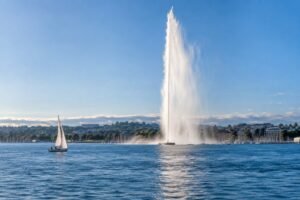
The afternoon belongs to the water. Geneva’s most recognizable landmark is the Jet d’Eau, a water jet that shoots 140 meters into the air from a pier on Lake Geneva. It was originally installed in 1891 as a pressure-release valve for the city’s hydraulic network — the same network that once powered Geneva’s industrial machinery. The coincidence of engineering necessity producing one of Europe’s great urban symbols is very Swiss.
Walk down from the Old Town to Quai Gustave-Ador on the Rive Gauche. In good weather, a walkway lets you stroll out on the jetty within spraying distance of the jet itself. Budget 15 minutes and bring a light jacket — the mist radius extends significantly further than it appears from the promenade. On sunny afternoons a rainbow forms in the spray. Entry is free; it operates year-round except in very strong winds.
Jardin Anglais and the Flower Clock
Continue west along the Rive Gauche waterfront to the Jardin Anglais (English Garden), a public park bordering the lake. The Horloge Fleurie (flower clock) here has been a Geneva symbol since 1955 — its face is planted fresh each season with approximately 6,500 flowers, and its second hand holds the distinction of being the longest in the world at 2.5 meters. It is free, always open, and photographed by virtually every visitor to Geneva. The garden connects directly to Pont du Mont-Blanc, making it a natural crossing point to the Rive Droite.
Bains des Pâquis — Where Geneva Actually Goes
Cross the bridge to the Rive Droite and walk 10 minutes north along the waterfront to reach Bains des Pâquis, the city’s beloved public lakeside baths. Built in 1872 on a pier extending into the lake, this institution has been Geneva’s communal gathering point across generations. In September, the lake temperature sits around 18 to 20°C — entirely swimmable. Entry costs CHF 2, which is an extraordinary figure for a lakeside facility in one of Europe’s most expensive cities.
The Bains des Pâquis café serves fondue in winter and sandwiches year-round at prices that feel borrowed from a different, cheaper city. What makes it consistently recommended by Geneva residents rather than guidebooks is precisely that it functions as a public space for everyone — retirees, families, students, and visitors — rather than as a curated tourist experience. The view from the pier directly faces the Jet d’Eau across the water.
Day 1 Evening: Dinner in Carouge, Geneva’s Bohemian Quarter
Carouge is where Geneva goes on a Friday night, and most visitors spend their evenings in Les Pâquis or the Old Town without ever knowing it exists. This neighborhood, founded in 1786 by King Victor Amadeus III of Sardinia as a commercial rival to the then-independent city of Geneva, sits 15 minutes south of the center by tram (line 12 or 13, direction Bachet-de-Pesay, exit Carouge-Marché).
Its architecture is Sardinian — low buildings, internal courtyards, ochre-colored facades — which gives Carouge a completely different visual character from the rest of Geneva. The restaurant density per street is high, and the quality-to-price ratio is the best in the city. La Cantine de Carouge on Rue Ancienne does Swiss regional cooking well, including a fondue moitié-moitié (half Gruyère, half Vacherin) at CHF 28 per person. La Calade on Place du Marché runs a shorter, sharper menu of Mediterranean-influenced dishes using local Swiss ingredients.
After dinner, walk the streets around Rue Saint-Joseph and Rue Jacques-Dalphin. Carouge has one of the best-curated independent wine bar scenes in Geneva — several bars focus specifically on Swiss wines, which rarely appear outside Switzerland and are worth seeking out. Look for Chasselas from the Lavaux region (a UNESCO-listed vineyard terrace 40 minutes east of Geneva) and Pinot Noir from Valais. Both are revelatory if your Swiss wine experience starts and ends at “I didn’t know Switzerland made wine.”
Day 2 Morning: International Geneva and the United Nations District
The second morning is about the part of Geneva most visitors skip entirely: the cluster of international organizations north of the city center that have made Geneva the global capital of humanitarian diplomacy. The Quartier des Nations sits about 2 km north of the train station — tram 15 from Cornavin, direction Nations, 12 minutes.
Palais des Nations and the Broken Chair
The Palais des Nations is the European headquarters of the United Nations and the most conference-intensive building in the world, hosting over 10,000 international meetings per year. Guided tours (CHF 15, bookable at unog.ch — advance booking strongly recommended on weekends) take you through assembly halls where landmark agreements on nuclear non-proliferation, chemical weapons, and refugee protection have been negotiated. Bring your passport: security is not performative.
Outside the main entrance on Place des Nations, the Broken Chair stands 12 meters tall — a wooden sculpture of a four-legged chair with one leg shattered at the knee. Installed in 1997 by Swiss NGO Handicap International as a protest against anti-personnel mines, it has become one of the most quietly effective pieces of public advocacy art in the world. The UN has repeatedly tried to remove it; the Swiss authorities and the NGO have repeatedly kept it in place. Photograph it, read the plaque, and take five minutes to think about what it represents. That combination of physical weight and political meaning is very Geneva.
International Red Cross and Red Crescent Museum
Five minutes’ walk from the Palais des Nations, the International Red Cross and Red Crescent Museum is, without qualification, one of the best museums in Europe for its size. The permanent exhibition — renovated in 2020 — covers the history of the ICRC movement, the development of international humanitarian law, and the realities of contemporary conflict through an immersive, morally serious installation that never becomes exploitative or didactic.
Entry is CHF 15 for adults, CHF 7 for students. Plan 90 minutes minimum. The museum café is excellent and serves a full lunch menu — it is a better midday stop than most restaurants in the immediate area. From the museum, you are positioned perfectly for the afternoon’s return to the city center.
Day 2 Afternoon: A World-Class Museum and Rue du Rhône
After the Red Cross Museum, tram back toward the center. The afternoon splits depending on your interests — Geneva offers two genuinely outstanding afternoon options that fit within a 2-day itinerary.
Option A: The Patek Philippe Museum
In the neighborhood of Plainpalais (tram 12 from Nations, 20 minutes), the Patek Philippe Museum houses the finest public collection of watches and watchmaking history in the world. Five floors cover automata from the 16th century, miniature enamel portraits, pocket watches, historical movements, and the full arc of Geneva’s watchmaking industry from its origins as a Protestant craft refuge (Huguenot watchmakers fleeing France settled in Geneva after the Edict of Fontainebleau in 1685) to its current position as the global center of haute horlogerie. Entry CHF 10. Closed Mondays.
Option B: MAMCO (Museum of Modern and Contemporary Art)
Also in Plainpalais, the MAMCO (Musée d’Art Moderne et Contemporain) occupies a converted industrial building and holds Geneva’s main collection of post-1960 contemporary art. The permanent collection is displayed in rotating configurations, which means repeat visits yield different experiences. Temporary exhibitions are consistently sharp. Entry CHF 15; free on the first Sunday of each month.
Rue du Rhône and the Final Walk
Rue du Rhône is Geneva’s luxury shopping street, where Rolex, Patek Philippe, Chopard, and Cartier maintain flagship boutiques in 19th-century buildings with interiors worth visiting even if you have no intention of buying. The adjacent Rue du Marché and Rue de Rive carry more accessible retail including Swiss chocolate specialists — Läderach and Favarger are both excellent and sell single bars and small selections rather than forcing you into tourist-sized gift boxes.
Close the two days with a walk along the Quai du Mont-Blanc on the Rive Droite in the late afternoon light. This promenade faces directly across the lake toward the Jet d’Eau on the Rive Gauche and, on clear days, gives a direct sightline to Mont Blanc (4,808 meters) on the French-Italian border. According to MeteoSwiss data, Mont Blanc is visible from Geneva on approximately 100 days per year — autumn (September–October) has the highest rate of clear sightlines. If you see it, stop walking for a moment. It is a remarkable view.
Getting to Geneva and Around the City in 2026
Geneva Airport (GVA) connects to over 100 destinations across Europe, the Middle East, North America, and Africa. The airport sits just 4 km from the city center — the shortest gap between a major European airport and its city’s center. Compare cheap flights to Geneva across all airlines here before booking — prices vary substantially by day of week and advance purchase window.
From the airport, the Léman Express train runs every 10 minutes and reaches Gare de Cornavin in 8 minutes flat. Single ticket: CHF 3.40. Better still: when you collect your bags, find the free transport ticket machine in the baggage reclaim hall. Geneva Airport issues arriving passengers a free 80-minute public transport pass — a policy that exists nowhere else in Europe at this scale and that the airport has maintained since 2013.
Combining Geneva with other Swiss cities is straightforward and rewarding. Lausanne is 45 minutes east by train; Montreux and the Lavaux vineyards are 1 hour; Bern is 2 hours; Zurich is 2 hours 45 minutes on the direct InterCity service. Book your Swiss train tickets in advance here — SBB trains are reliable to the minute, but popular routes on weekends fill quickly, and reserved seats cost only CHF 5 extra.
Within Geneva, trams 12, 13, 14, and 15 connect all the neighborhoods in this itinerary. Your hotel’s Geneva Transport Card covers all rides. PubliBike docking stations throughout the city offer bike rental at CHF 5 per hour or free for 30 minutes via the PubliBike app — useful for the lakeside sections where cycling feels better than walking.
Where to Stay in Geneva for a 2-Day Weekend
Geneva has a well-earned reputation as one of Europe’s most expensive cities for accommodation. That is accurate at the luxury tier and during major conference weeks. At other times and price points, the situation is more manageable than the reputation suggests.
- Budget (CHF 80–130/night): Youth hostels in Les Pâquis and Plainpalais are the clearest options. Hôtel Bel’Espérance in the Old Town is a genuine budget hotel with character, operated by the Salvation Army since 1929, and is one of the better-positioned budget options in the city center.
- Mid-range (CHF 150–260/night): Boutique hotels in Carouge and Les Pâquis. Hôtel N’vY, a design hotel near the station, consistently gets strong reviews for its location, modern rooms, and breakfast quality. Hôtel Auteuil on Rive Gauche is another reliable mid-range option.
- Luxury (CHF 400–900+/night): Four Seasons Hotel des Bergues on the Rive Droite (operating since 1834, rebuilt) and Beau-Rivage on the Rive Gauche are the two classic Geneva luxury addresses. Upper-floor rooms at both properties have direct Jet d’Eau views.
Whatever your budget, book your Geneva hotel early via Trip.com — Geneva is a year-round conference city, and rooms in all categories can disappear weeks ahead of major UN sessions (September–October is particularly competitive).
Geneva Weekend Budget: Practical Numbers for 2026
A realistic daily budget for a Geneva weekend, excluding flights and accommodation, is CHF 100–150 per person. Here is what that buys:
- Museum entries for the day: CHF 15–30 (the best sights cost CHF 8–15 each; several are free)
- Lunch using a restaurant’s midday menu (plat du jour): CHF 18–22 for two courses — Swiss restaurants almost universally offer this; the same dishes at dinner cost 40% more
- Dinner in Carouge or Les Pâquis: CHF 30–45 per person including one drink
- Incidentals (coffee, chocolate, a boat ride): CHF 15–25
- Transport: CHF 0 with the hotel Geneva Transport Card
Budget travelers who use supermarket lunches — Migros and Coop both sell excellent Swiss cheese, bread, and wine at honest prices — can manage CHF 60–80 per day while still hitting every museum. A lake picnic from Coop with Gruyère AOP, Emmental, and a bottle of Chasselas from the Lavaux costs around CHF 14 and is genuinely one of the better meals available in Geneva at any price point.
Several of Geneva’s best attractions are completely free: the Jardin Anglais, the Broken Chair, the Jet d’Eau from the promenade, Maison Tavel (city history museum), the Jardin Botanique, and the Musée d’Art et d’Histoire (permanent collection). Bains des Pâquis charges CHF 2 — the lowest entry price of any lakeside facility in Western Europe.
Best Time to Visit Geneva for a Weekend Trip
Geneva functions well in every season, but each period has a different character:
- Spring (April–May): The parks and gardens are in bloom, crowds are manageable, and temperatures (12–20°C) are comfortable for walking. The best overall balance of weather, price, and availability. Book hotels 3 to 4 weeks ahead.
- Summer (June–August): Lake swimming at Bains des Pâquis is excellent. Temperatures reach 22–28°C. Outdoor restaurant terraces are open. Peak prices and some crowds, but the city’s scale handles them without feeling overwhelmed.
- Autumn (September–October): The clearest skies and the best chance of seeing Mont Blanc from the Quai du Mont-Blanc. Grape harvest season in the Lavaux vineyards (40 minutes by train) makes a half-day wine excursion exceptional during this period. Book hotels early — UN General Assembly sessions in September and October fill the city.
- Winter (November–February): Geneva’s Christmas market on Place du Rhône is authentic rather than commercial. January and February are the quietest and most affordable months, with hotel rates sometimes 30 to 40% below summer peaks.
For a deeper overview of how Geneva fits into a longer Switzerland trip, read our guide to the best places to visit in Switzerland in 2026 and our Switzerland train travel guide for combining Geneva with Lausanne, Interlaken, and Bern on a single rail pass.
Geneva in 2 Days: Final Thoughts
Geneva rewards visitors who look past its reputation — expensive, corporate, diplomatic — and spend time in its actual neighborhoods. The Old Town is medieval and walkable. Carouge is a neighborhood that functions for people who live there, not for people passing through. Bains des Pâquis is a public institution that has resisted the logic of commodification for 150 years. The Red Cross Museum asks hard questions and expects you to sit with them.
Two days is the right amount of time to see the shape of Geneva clearly without exhausting it. If you have a third day, take the train to Lausanne or Montreux and walk through the Lavaux vineyards above the lake — but that is a different itinerary entirely. For now, Geneva in 2 days is a self-contained and satisfying thing, and this is how to spend them well.
Editorial standards
Why trust this guide
- Route-checked. Itineraries, transfers and timings are verified against current public-transport schedules and operator pages.
- Honest comparisons. Hotel areas and tours are compared on real value — affiliate links never change the recommendation.
- Transparent. Some links are affiliate links; the disclosure is shown on every guide.
This guide is informational travel content, not professional travel, financial or legal advice. Always confirm prices, opening times and conditions with the official provider before you book.