Switzerland Travel Guide 2026: How to Visit the Alps Without Going Broke
This article contains affiliate links. We may earn a commission at no extra cost to you.
Switzerland Travel Guide 2026: How to Visit the Alps Without Going Broke
- 💰 Daily budget: CHF 100–150 (budget) | CHF 200–350 (mid-range) | CHF 400+ (splurge)
- ⏱️ Recommended duration: 7–10 days for the main circuit
- 📅 Best time: June–September (hiking) or December–March (skiing)
- 🚂 Essential: Swiss Travel Pass or Half Fare Card for public transport
Switzerland is expensive — but not unmanageably so if you know the system. After three visits, including a two-week rail circuit in September 2025, I’ve developed a clear picture of where the money goes, what’s worth paying full price for, and where Switzerland’s generous public infrastructure actually saves you money compared to renting a car in equivalent countries. This guide is specifically designed to help you have an exceptional Swiss experience without hemorrhaging money unnecessarily.
Top Experiences in Switzerland
The Jungfraujoch — “Top of Europe”
The train journey from Interlaken to the Jungfraujoch (3,454m) is among the most spectacular rail experiences in the world. The summit has a research station, ice palace, and views of the Aletsch Glacier — the longest in the Alps. Cost: CHF 218 round-trip from Interlaken (free with Swiss Travel Pass). Weather is critical — check the forecast and reschedule if cloud-covered. A clear day here is transformative; a cloudy one is expensive fog.
Grindelwald and the Eiger
The village of Grindelwald, beneath the north face of the Eiger, is the most dramatically situated town I’ve encountered anywhere. The First Gondola (CHF 78 round-trip, included with Swiss Pass for 50% reduction) takes you above the treeline for views that justify Switzerland’s entire reputation. The Via Ferrata (protected climbing route) is accessible to non-climbers with rented equipment.
Lucerne
Lucerne’s old town — medieval walls, painted bridges, a pristine lake, and the Alps as backdrop — is the quintessential Swiss postcard. It’s also genuinely beautiful in person. Mount Pilatus (accessible by the world’s steepest cogwheel railway) and Mount Rigi offer panoramic views. The Swiss Museum of Transport is unexpectedly excellent and worth 3 hours.
Zermatt and the Matterhorn
Zermatt is car-free (take the cog railway from Täsch) and dominated by the Matterhorn’s distinctive pyramidal shape. The Gornergrat Railway (CHF 94 round-trip, 50% with Swiss Pass) climbs to 3,089m with the Matterhorn filling your view. Even in September, this area feels remote and wild. Zermatt village is expensive but atmospheric — one night here is worth it.
The Bernese Oberland Lakes
Thunersee and Brienzersee — the lakes flanking Interlaken — are accessible by free boat trips for Swiss Pass holders. The lake water is an impossible turquoise blue from glacial minerals. Lake Brienz has the Giessbach Waterfall (free with Swiss Pass boat) which you can hike to for one of Switzerland’s most romantic natural spectacles.
Swiss Travel Pass — Is It Worth It in 2026?
The Swiss Travel Pass gives unlimited travel on trains, boats, and many mountain railways, plus free entry to 500+ museums. The critical question: does the math work for your itinerary?
| Pass Type | Cost (CHF) | Best For |
|---|---|---|
| 3-Day Flex | CHF 244 | Short trips focusing on one region |
| 4-Day Flex | CHF 299 | Zürich + Lucerne + Interlaken circuit |
| 8-Day Consecutive | CHF 399 | Full Switzerland circuit |
| 15-Day Consecutive | CHF 499 | Extended exploration including mountain excursions |
| Half Fare Card | CHF 120 | 1-month pass for 50% off all fares |
The verdict: For 7+ days of active travel covering Zürich, Lucerne, the Bernese Oberland, and Zermatt, the Swiss Travel Pass pays for itself. A single Jungfraujoch journey (CHF 218 at full price, free with pass) plus the Brienz boat (CHF 50) plus train fares between cities (CHF 30–50 each) reaches the pass cost within 2–3 days. For shorter stays or base-staying in one area, the Half Fare Card is usually better value.
You can purchase the Swiss Travel Pass via official partners before departure — booking in advance through authorized sellers sometimes offers marginal discounts and ensures availability.
Where to Stay in Switzerland
Budget (Under CHF 100/night)
Swiss YHA hostels are excellent — clean, well-located, and often in stunning settings (the Gimmelwald hostel literally hangs on a cliff above the Lauterbrunnen Valley). Budget: CHF 40–75 for dorm beds. Private rooms: CHF 80–100 in hostels.
Mid-Range (CHF 120–220/night)
Interlaken, Lucerne, and Grindelwald all have good mid-range hotels. Key tip: book Sunday–Thursday nights when business travel demand drops 20–30%. Hotel Kreuz in Grindelwald (CHF 140–180) offers mountain views and a reliable buffet breakfast.
Splurge (CHF 300+/night)
The Mont Cervin Palace in Zermatt (CHF 380–600/night) and the Palace Hotel in Lucerne (CHF 450–800/night) are the benchmark Swiss luxury experiences. For the Matterhorn view room at Mont Cervin specifically, book 4–6 months ahead.
How to Save Money in Switzerland (Without Suffering)
Food: The Biggest Variable
Restaurant meals in tourist areas: CHF 25–45 per main course. Two strategies that work: (1) Supermarkets — Migros and Coop have excellent hot and cold prepared food sections, sandwiches and meal deals for CHF 8–15. (2) “Mittagessen” (lunch menu) specials — restaurants that would charge CHF 40 for dinner often have a CHF 18–22 lunch menu with the same quality. According to Switzerland Tourism’s 2025 visitor survey, accommodation and food account for 68% of total visitor spending — food strategy has outsized budget impact.
Mountain Transport
Many hikes start at mid-station rather than the base, reducing cable car costs by 40–60%. The Niesen Staircase (10,686 steps — the world’s longest) is free to hike up and costs CHF 22 round-trip by cable car. The Sigriswil rope bridge and Aare Gorge (CHF 7) are spectacular low-cost alternatives to expensive mountain railways.
Getting Around Switzerland by Train
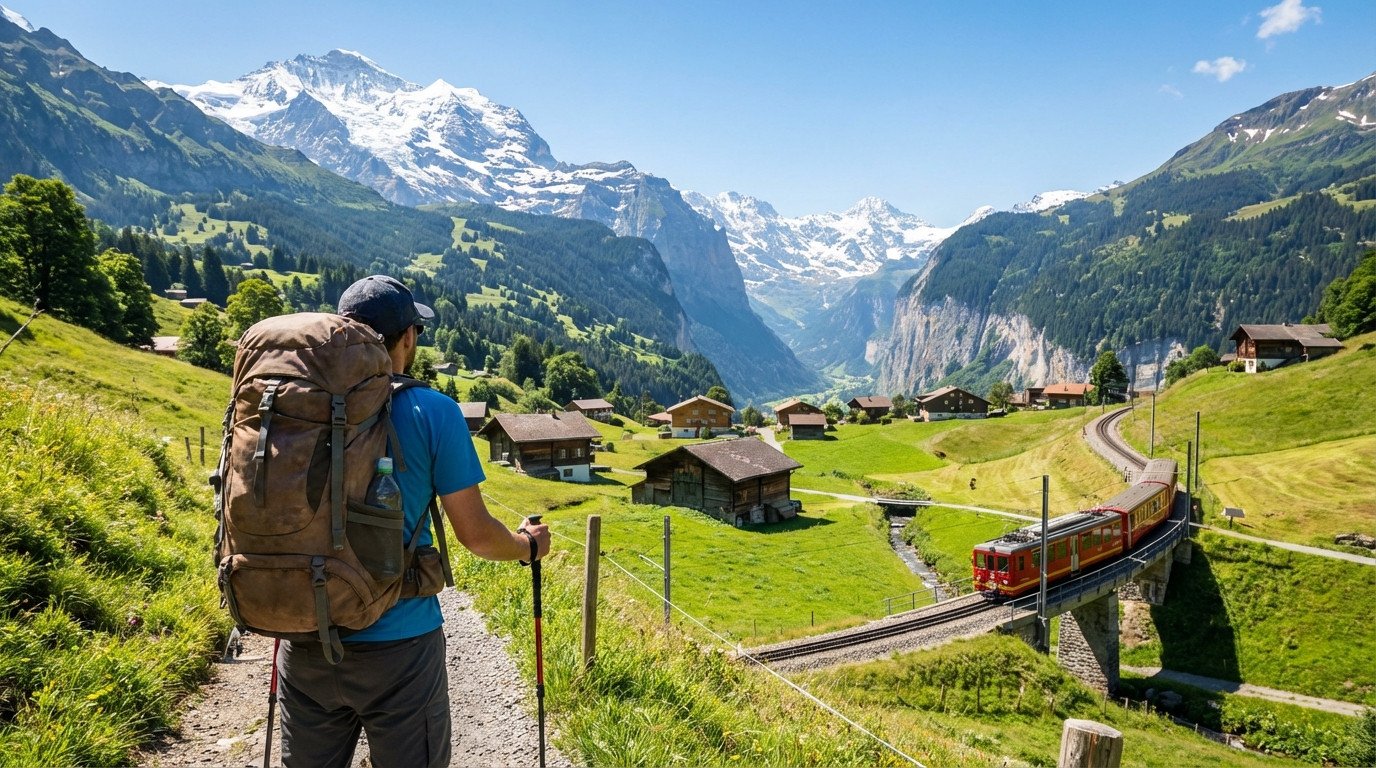
Switzerland’s train system is the finest in the world by most objective measures: punctual, clean, well-networked, and scenic. The InterCity network connects all major cities with hourly departures and journey times under 2 hours. Regional trains and PostBuses extend coverage to almost every village.
The Glacier Express (Zermatt to St. Moritz, 8 hours) and Golden Pass Line (Montreux to Lucerne) are scenic railway experiences that also serve as practical transportation — unlike many “tourist trains” in other countries, these are standard fare services with real scheduling utility.
7-Day Sample Itinerary
- Day 1–2: Zürich. Old town, Swiss National Museum, lakeside promenade. Day 2: Lucerne day trip (1 hour by train).
- Day 3: Travel Zürich → Interlaken (2 hours). Afternoon: Lake Brienz boat to Giessbach.
- Day 4: Jungfraujoch excursion. Full day — choose based on weather forecast.
- Day 5: Grindelwald. First Gondola or hike through the Eiger Trail.
- Day 6: Travel Interlaken → Zermatt (via Visp, 2.5 hours). Zermatt village + Gornergrat Railway.
- Day 7: Zermatt → Bern (3.5 hours). Old town UNESCO walk, Bear Park, Rosengarten panorama. Evening train to Geneva or Zürich airport.
Frequently Asked Questions
Is Switzerland too expensive for budget travelers?
Switzerland requires accepting that some costs are fixed and unavoidably high (mountain transport, restaurants). Budget travelers who use supermarkets for lunch, stay in YHA hostels, and use the Swiss Half Fare Card can realistically manage CHF 80–100/day (approximately €85–105). It’s more than Western European alternatives but the experience quality-to-cost ratio is exceptional if you plan strategically.
When is the best time to visit Switzerland?
June–September for hiking, mountain access, and pleasant weather (15–25°C at valley level). December–March for skiing — major resorts (Zermatt, Verbier, Davos) are open with reliable snow. The shoulder seasons (May and October) offer lower accommodation prices with still-reasonable weather. Avoid August if possible — peak prices and maximum crowds.
Is the Swiss Travel Pass worth buying?
For 7+ days of multi-city travel covering the Bernese Oberland, Lucerne, and Zermatt: yes, it pays for itself. For 3-4 day stays focused on one region: the Half Fare Card (CHF 120 for 1 month of 50% discounts) is usually better value. Calculate your planned journeys before buying — the Swiss Federal Railways website has a fare calculator to verify the math for your specific itinerary.
Do you need to speak German, French, or Italian in Switzerland?
English is widely spoken in tourist areas and among the under-50 population throughout Switzerland. German is dominant in central/eastern Switzerland, French in the west (Geneva, Lausanne, Montreux), and Italian in the south (Ticino). A few words in the local language are appreciated but never necessary for a comfortable visit.
What is the best way to see the Swiss Alps without spending a fortune?
Priority mountain experiences that offer exceptional value: Schynige Platte (free with Swiss Pass, stunning ridge walk), Niesen by foot (free), Lake Brienz boat (free with Swiss Pass), and the Lauterbrunnen Valley itself (valley floor is free, waterfalls visible from the road). Save the expensive mountain railways (Jungfraujoch, Gornergratt) for clear weather days when the investment pays off in visibility.